Showing posts with label Sitting. Show all posts

Tuesday, October 20, 2015

The Drawbacks of Using A Treadmill Desk

The treadmill desk is one of the health trends in recent years that are slowly gathering a following. It’s no surprise, since the benefits of using one in your workspace are many, and you’ve probably heard them all. However, does that mean that using a treadmill desk has no drawbacks? The answer to that might be no. Before you invest in a treadmill desk, be sure that you are okay with the drawbacks that it may present.

Cost

Let’s face it; ready-made treadmill desks are not cheap. In fact, the prices of some treadmill desks go into the thousands. Compared to the prices of regular sit-down desks, this can seem ridiculous, especially if you have a small budget. Of course, you can build your own treadmill desk for a lower cost, but you will still have to spend quite an amount of money.

Suitability

While you can reap the benefits of using a treadmill desk if you use one, what happens if you can’t use it? Not everyone is capable of working and walking at the same time, as this requires some coordination. If your coordination is downright bad, you may find using a treadmill desk difficult, or even impossible.

Size

A treadmill desk is a convenient way to get a “gym” into your office, but that doesn’t mean that it does not take up space. The average treadmill desk is quite big, which may not make it suitable if your workspace is just a small cubicle at work. However, this does make it a good reason to work hard, get a promotion, and get a bigger office.

Maintenance

Naturally, maintaining a treadmill desk is going to take a little extra effort compared to a regular desk. If you can’t even keep your regular desk at work clean, you may want to think twice before getting a treadmill desk. It’s not that a treadmill desk takes a whole lot of maintenance; it’s just that if you’re lazy, any extra maintenance is going to be a burden.

All in all, there are some drawbacks to using a treadmill desk, but for most people, these drawbacks are trivial compared to all the benefits it can offer. If you feel you are well-coordinated enough to work while moving, and you really want to make the best use of your time at the office, then go ahead and consider buying a treadmill desk. You will probably wind up loving it.

Tuesday, April 7, 2015

How to Fit More Movement Into A Sedentary Lifestyle

As you read this, you’re probably sitting down. In fact, you’ve probably been sitting down for most of the day. Although you’re far from being the only one, it’s important that you try to incorporate more activity into your daily life or - as we discussed last week - your health will suffer. It's easier said that done when you’re so used to inactivity! Here are some tips to help you get started.

Understand the Risks

Although you probably already know that you need to move more, you might not be completely clear on the risks of not moving. And, make no mistake, the risks are big. Humans were designed to be active, we were not designed to sit in a chair for the whole day before retiring to our beds. And, even if you do fit in an hour of exercise, it doesn’t undo the negative effects of sitting down too much.

Research shows that inactive people are more likely to develop conditions such as heart disease, cancer and diabetes. You’re also more likely to be overweight, and to suffer from mental health problems. (See last week's post for more on this.)

OK, I Know the Risks! But How Do I Motivate Myself?

English: Exercising outdoors is healthier than...
(Photo credit: Wikipedia)
Even when you know all the risks, it can still be hard to force yourself to get up and be active. This is especially true if you are overweight, although a good first step in that case can be to visit your doctor and get their recommendations on how to slowly get moving.

One big factor is changing your mindset. Instead of the idea of walking to work or the grocery store as a chore or a waste of time, see it as an opportunity to get moving! Instead of being lazy and always taking the elevator, walk up the stairs (if you live or work high up in a building, even just taking some of the stairs can help!)

You also need to get rid of the idea that you don’t have the time to move more – you do, you just need to incorporate it naturally into your daily life. For example, when socializing with friends you could all agree to meet up for a walk around the local park, rather than sitting in a coffee shop. Or you could move around while you watch your favorite TV show instead of sitting on the couch! Although you might think this won’t work with your life, you’ll be surprised at how many opportunities there are to get active once you shift your mindset and look at things differently.

Next, understand that there are many ways to move beyond exercise. For example, many people are starting to stand up while they work at the computer, by putting together a standing-height desk, or by placing their laptop on a higher surface. (See Dr. James Levine's excellent book, Move a Little, Lose a Lot for more on this type of activity.) Running around with your kids (or dog) or dancing to your favorite music are also great ways to get moving. A thorough house-cleaning or gardening session even counts as great activity! At the very least, simply try getting up and stretching at least once an hour if you sit a lot.

Lastly, realize that old habits take time to change. If you’re used to sitting down for all but an hour every day, then it’s going to be hard to change. Not only will you find it tiring being on your feet more, but you’ll also find that it can be hard to motivate yourself. This is completely normal, which is why you should try to make changes gradually, until they become part of your daily routine.


Tuesday, October 21, 2014

How To Stretch Your Back When Sitting In An Office Chair All Day

Let’s face it; having an office job which requires you to sit at your desk all day can be detrimental on your back, especially as you get older. Plus, it’s difficult to maintain a proper back posture when you’re concentrating on your work. Getting up and walking around at least twice an hour can help, but it isn't always enough. That’s why it’s important to regularly stretch your back. Here are some simple back stretches that you can do right in your chair.

Seated Back Twist

To do this stretch, you need to sit on your chair and plant both feet flat on the ground. Then, while holding the back of your chair, gently twist your body to one side to stretch your spine. Be sure to keep your spine straight and don’t overdo it or you can injure your back. After twisting to one side, you can rotate your torso and gently twist your body to the opposite side.

Chin Tuck

This stretch is effective to loosen the muscles in your neck, shoulder, and upper back. To do the chin tuck, simply lower your chin to your chest and stretch the back of your neck. You can also use your hands to push your head down with a slight pressure to further stretch your neck.

Lower Back Stretch

To do this stretch, you have to sit upright in your chair and make sure you have ample space in front of you. You then bring one knee towards your chest and hold it there for a few seconds with your hands. Make sure you feel the stretch in your lower back. You can then repeat the stretch with your other knee.

Seated Forward Bend

The seated forward bend allows you to stretch your whole back as well as your shoulders and neck. Just like when doing the lower back stretch, make sure that you have enough space in front of you. With both your feet flat on the floor, raise both hands above your head and bend down slowly towards your knees. When your chin reaches your knees, hold that position for a few seconds before you slowly rise back up.

Cat-Cow Back Stretch

This stretch is a very simple stretch which is great for the neck and upper back. To do it, sit upright with your hands on your knees, and inhale slowly while raising your head up and arching your back. Hold for a few seconds and exhale while dropping your chin down to your chest and rounding your spine. You can repeat this stretch a few times.

There are many easy back stretches you can do in your office chair. All you need to do to relieve the tension from your back is to take a few minutes every day to stretch your back. However, make sure you carry out the stretches slowly and with good form so you don’t end up injuring your back instead.

Tuesday, April 2, 2013

Yoga for Computer Users: Relieving Low Back Pain

Suffering with an episode of back pain this week (my last one was 6 months ago, and not that severe, so I've definitely been improving over the past few years!) I was reminded of how miserable it can make people. The default solution for back pain from the conventional medical industry is pain pills or surgery. However, twenty percent of all those who undergo surgery for lower back pain will get no relief. The remaining 80 percent will have continued problems ranging from mild to severe. All will have trouble with spinal flexion.

In anatomy, lumbar is an adjective that means ...
The lumbar region is most affected by sitting. (Photo credit: Wikipedia)
For some (like me) regular practice of yoga may help. Yoga does not offer cures. It simply promises that if you faithfully practice these asanas every day, there will be reduced episodes of pain and you will build up a strong and supple spine, restructuring posture and body image.

Once you have back problems you must remain conscious all through the day of how you stand, sit and lie down. Here are a few general guidelines:
  • Always sleep on a firm (not necessarily hard) bed, with a flat pillow under your head and a thicker one under your knees. This will help the spine to reposition and adjust itself.
  • Do not wear high heels as this promotes lumbar lordosis and throws the spine out of balance.
  • When experiencing pain (even mildly) do not go in for break-dancing, strenuous aerobics, jogging, running or anything where you need to bounce or jiggle. Guarded activity is the key here.
For lower back pain, sitting is the most painful - and I can certainly attest to this. Sit on a firm seat, not squashy cushions, and sit on your buttock bones. Do not loll back on the tailbone or lower spine. Wedge a rolled towel or small cushion behind your back to keep you upright. Sit as often as possible in The Diamond Posture (instructions below)* in order to benefit the sciatic nerve and to cure a convex or a lateral curvature of the spine.

You may wish to consult a chiropractor and see if they can be of help - in some cases of acute pain, a chiropractic adjustment can provide immediate relief.

When the pain is acute and you can neither sit nor stand in comfort, rest in bed, apply ice packs to the area regularly, take whatever anti-inflammatory or analgesic medications your physician prescribes, and wait until the pain is milder before attempting any yoga postures.

Yoga postures Vajrasana
Diamond Pose - Vajrasana (Photo credit: Wikipedia)
These yoga asanas have healing and curative properties. They will act as a form of mild traction, gently stretching the spinal muscles in safe extension postures. Strength will be gradually built up in the paraspinal muscles and buttocks, abdominal organs will be toned and strengthened, and pressure points all along the spine will be stimulated.

* The Diamond Posture (Vajrasana)
Kneel on a thick carpet or blanket with your knees close together. Sit back on your heels and stretch up from your hips, balancing your head well so that a line drawn  through ear, shoulder, elbow and hip would be straight. You should sit often in this posture for greatest benefits.

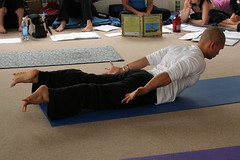
Al in Salabhasana A
Locust Pose (Salabhasana) A (Photo credit: dejahthoris)
The Locust (Salabhasana)
Most yoga students are familiar with this posture. Lie flat, face down, chin on floor. Make your hands into fists and push them either under your thighs to help the lift, or place them alongside your body. Exhale and lift legs from your hips, tightening your  buttocks and stretching your legs up and back. Hold position for as long as possible, exhale, return to starting posture and repeat.

Advanced Hatha Yoga Video Cobra Pose - Bhujang...
Cobra Pose - Bhujangasana (Photo credit: myyogaonline)

Cobra Pose (Bhujangasana)
Lie face down, legs stretched back, buttocks tightened and knees pulled back. Place hands just below shoulders, exhale and lift head, then chest, shoulders and torso, pushing down from your pelvis and straightening your arms. From the back of your head to your tailbone, your body should be curved back. Push shoulders back and down. Push head back more. Stay like this as long as possible with normal breathing. Come down very slowly, and relax.

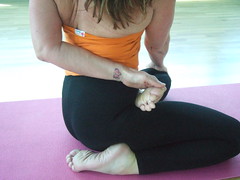
Seated twist (Bharadvajasana)
Seated twist (Bharadvajasana) (Photo credit: yogamama.co.uk)
The Twist (Bhardwajasana)
Kneel on the floor and sit back, bringing both feet to the right of your hips. Straighten your right arm, bring it across your body and turn to the left. Place your hand, palm down under your left knee. Exhale, turn your body more to the left and  clasp your right elbow with your left hand, from the back. Turn your head and gaze over your right shoulder. Fold position for a few breaths and then twist and look back over your left shoulder. Shoulders should be at right angles to the body. Come back to starting position and repeat on other side.  You should do this posture once every hour if you have lower back pain.

Check back later this week for some more yoga postures that can be of great benefit to frequent computer users, and others who spend much of their day sitting.


Enhanced by Zemanta

Tuesday, September 11, 2012

Four Exercises You Can Do at Your Desk

A sedentary person, or "typical couch pot...
A sedentary person, or "typical couch potato." (Photo credit: Wikipedia)
Today's sedentary lifestyle causes more health problems than most people realize, or can even imagine. Sedentary lifestyles have been linked to dozens of obesity-related diseases and health problems, and it's no wonder why. It has been a fairly recent development in human history that many of us sit at desks all day and aren’t up and about performing physical activity. 
The human body wasn’t designed to just sit around, which is partially why obesity and other health concerns related to physical activity have become such a problem.  The good news is, being strapped to a desk all day doesn’t mean you can’t perform activities to stay healthy.  Here are 4 great exercises you can do to stay active without leaving the comfort of your cubicle. 

Quick Cardio
In order to keep your heart healthy, you have to elevate your heart rate often.  And it's not necessary (or even best) to elevate it for 20-30 minutes at a time, as conventional exercise "wisdom" would have you believe.  If you have 5 minutes free during the day, that’s enough to get the blood pumping.  Here’s a great way to get your blood moving without having to leave your chair.  First, pump your arms up and down above your head for 30 seconds.  Next, then tap your feet rapidly back and forth like you’re trying to run in place.  Now alternate these back and forth for about 5 minutes. 

Arm Stretches
Stretching your arms and wrists is a great idea if you sit at a desk all day and type.  It can help relieve stress from the repeated actions.  Here are some wrist and arm stretches that can be done quickly and easily.  First extend your arm in front of you with your wrist bent back so your palm is facing out.  Use the other arm to pull back your hand; you should be able to feel your whole arm stretching out.  After repeating this exercise with both arms, press your palms firmly together in front of you.  Be sure to keep your elbows bent and lifted.  Bend your wrists back and forth, pushing gently with your hands.

Leg Lifts
Constantly staying in the same position all day, whether sitting or standing can be damaging to your legs.  This simple exercise will help increase leg circulation and improve the health of your legs.  While sitting in your chair, simply extend one leg until it is straight.  Hold, the return it back to the floor.  Continue this exercise for a few minutes, alternating legs.  Lift one leg a few inches off the floor while keeping your knees bent.  Again, you should hold and release, then repeat for a few minutes with both legs.

Back Stretches
Sitting or standing on your legs all day can not only damage your legs, it can be murder on your back.  The best way to relieve back pain at work actually takes no extra time out of your day, it just requires a bit of concentration.  Just make sure you use proper posture throughout the day.  Sitting straight up in your chair all day without slouching can cause long term relief of pain.  If you need temporary relief of back pain, simply arch your back by pulling your stomach forward and bending your shoulders back. Repeat several times.  Another great way to stretch your back is to keep your lower body facing forward in your chair while turning around with your upper body. Do this several times on both sides.

While these exercises aren’t going to give you a killer body, they will help you feel better, relieve and prevent pain, and help improve your blood flow.
Enhanced by Zemanta

Tuesday, February 28, 2012

Avoid "Sitting Disease" with These Simple Tips

"Sitting disease" is the new catch phrase for a sedentary lifestyle. Scientists and doctors have learned that a sedentary lifestyle is much more dangerous than previously thought. In fact, we now know that it causes cardiovascular disease, diabetes, and shortens your life span.

The problem is that most people, perhaps yourself included, have a sedentary lifestyle by default. You sit at a desk all day. You sit in the car to get to and from work. Even children sit at a desk all day. Fortunately, the solution doesn't have to be complicated. You can escape sitting disease with a few simple tips.

1. Stretch

Spend time in the morning and throughout your day just getting up and moving your body. When you get out of bed, stretch your arms over your head. Bend over and touch your toes. Stretch from side to side too. This gets you immediately in touch with your body in the morning. Do the same thing throughout your day. Stand up, get away from your desk at least once an hour, and move your body.

2. The Whole Day Approach

Exercising during the day is a good thing. However, it doesn’t solve the “sitting disease” problem. If you still sit for more than seventy percent of your day then you’re probably sitting too much. Approach your day with a different ideology. Try to get up and walk every hour. Walk to the bathroom. Go get a drink of water. Go outside and get some fresh air.

English: Secretary of Defense Donald H. Rumsfe...Image via WikipediaWhen you run errands, park at the back of the lot and walk to the store. If you can stand at your desk and work, do that too. If you have something to ask or tell a co-worker then get up and go to their desk. Make moving a habit throughout your day.

3. Get a Standing Desk
If possible, get a standing desk. These desks are easy to make. You can even simply stack boxes on your desk and position your computer keyboard at waist level for a while. (One of my co-workers does this on a regular basis.)

4. Pace
When you’re on the phone, get up and move. Pace. It burns calories and it gets your body moving. Additionally, walking when you’re talking has been shown to stimulate brain activity. You may have more productive conversations.

5. Be an Active Watcher

When you watch television don’t sit on the couch, at least not the entire time. Get up during commercials. Get on the floor and stretch or do strengthening exercises. Get a folding walking treadmill and walk while you watch.

A Frisbee player catches the frisbee.Image via Wikipedia6. Make Leisure Time Active Time

What do you and your friends and family do together? Does it involve sitting for hours at a time? If so, consider changing your habits. Go for a hike together. Play football, Frisbee or go bowling.

Sitting disease doesn’t need to be combated by exercising for hours a day. Instead, look for ways to simply move your body more often. Your body was made to move. You have amazing joints, ligaments, tendons and muscles all designed to move! Use them regularly and often so you can stay healthy and live a long life.

Enhanced by Zemanta