Showing posts with label preventing arthritis. Show all posts

Thursday, March 28, 2013

Adding Exercise to Your Arthritis Treatment

Arthritis is an ailment which affects millions of people.  While some people may experience mild discomfort, others are in horrible and debilitating pain every single day.  No matter how mild or severe your pain is, you can probably benefit from some exercise.  Not only will it improve your overall health, it may also help combat some of your symptoms, leaving you pain free and help you with your symptoms.

Hip dysplasia with arthritis
Hip dysplasia with arthritis (Photo credit: Wikipedia)
We all know the importance of exercise, but arthritis patients will probably benefit more from strength straining exercises targeting their affected joints.  The best way to get this kind of workout is through a physical therapist.  They can provide you with exercises designed specifically to improve endurance, and muscle strength.  If you perform these exercises as prescribed, you will probably find yourself feeling better, or at least not deteriorating as quickly.  You may be able to do more, or your condition may simply worsen more slowly.  You can’t reverse the damage arthritis as caused, but you may be able to improve your quality of life.

Another type of exercise your physical therapist will probably recommend is flexibility training.  Many arthritis patients lose flexibility and range-of-motion in affected joints because pain is causing them to use the joint less.  Flexibility exercises can help keep the joints limber, enabling a better range or motion and increasing how much you can do with that joint.

A good cardio workout is just as important for people with arthritis as it is for everyone else.  However, unlike everyone else, people with arthritis don’t skip aerobic exercise because they’re busy, or tired - it’s because they’re in pain.  If performing everyday activities is painful, then you probably don’t want to consider doing anything more than that; however, there are exercises you can do to work your heart without severe pain or a worsening of your condition.  You should work with your doctor to find exercises that don’t stress, or even involve, the affected joints.  For instance, patients with severe knee arthritis can get aerobic exercise with table top bike-like devices which you pedal with your hands.  While this doesn’t help your affected joints directly, it improves your overall health, endurance, stamina, and circulation, which can improve your ability to handle your arthritis. Exercise can also temporarily relieve pain through chemicals in the blood. 

While exercise isn’t going to cure your arthritis, it may help to improve your condition.  To work properly, exercise should be combined with proper diet, getting enough rest, supplementation, and other treatments your doctor may recommend.  A combination of these therapies goes a long way for reliving arthritis pain. 


Enhanced by Zemanta

Saturday, January 26, 2013

Video: Yoga Exercises for Arthritis - Shoulders & Back

This video gives some gentle and helpful yoga exercises for easing arthritis pain and improving flexibility and range of motion for your shoulders and back. Doing these regularly can really help restore function and mobility for those with back and shoulder issues. (I don't have arthritis, but I do have a lot of stiffness in these areas, and these exercises feel great!)  Be sure to work at your own level, and don't strain or push yourself beyond where your body wants to go. She shows some modifications for those with limited mobility.

(Note: You may want to adjust your speakers - this one's a little on the quiet side.)

Yoga for Arthritis: The Shoulders and Back (Part 1)
The first 'Yoga for Arthritis' back sequence. Follow the stretches in the seated Cat Pose move to build and maintain mobility in an arthritic, sore, or stiff back. The shoulder poses are good for anyone with arthritis in the shoulder joints, or previ...


Thursday, January 24, 2013

Video: Knee Strengthening Exercise for Arthritic Knees

This short video demonstrates a very easy exercise that can help strengthen the muscles surrounding your knee, relieving and preventing pain caused by arthritis or injury. Doing this simple exercise on a regular basis can help you build up your strength and protect your precious knee joints from harm.

Knee Exercises - Arthritis Knee Exercise 2/8
Arthritis on the Knee can be devastating but performing some Arthritis Knee Exercises will help strengthen the muscles that help protect the knee. Even if you have Arthritis you still need to be able to workout the muscles in your legs to be able to ...

Enhanced by Zemanta

Tuesday, January 22, 2013

The Importance of Exercise for Preventing Arthritis

Your bones hang out in a lot of joints. Knee joints. Hip joints. The joints in your fingers and the joints in your toes.

Wherever bones meet, there is also cartilage, a rubbery, protective layer that ensures your joints bend smoothly and painlessly. But even cartilage cannot do this tremendous job alone. A thin membrane called the “synovium” provides fluid that lubricates the moving parts of the joint. When the cartilage wears out and the synovium becomes inflamed, the result is generally a case of “osteoarthritis”.

English: Knee femur cartilage Ελληνικά: O χόνδ...
Knee femur cartilage(Photo credit: Wikipedia)
In osteoarthritis, the cartilage can be eroded so much that bone does rub on bone. This type of arthritis develops gradually over a lifetime as a simple result of the wear and tear placed on your joints over the years. Very few people escape some degree of osteoarthritis, though the severity varies a great deal.

As a matter of fact, if you are over the age of 50, you are likely to have at least one joint affected by osteoarthritis. Osteoarthritis affects men and women equally and is by far the most common type of arthritis, with almost 16 million Americans in the list.

Exercising Your Prevention Options

Investing a little time in developing a good weight-bearing low-impact exercise and stretching plan can add up to great results when it comes to staving off arthritis pain. Strong muscles help protect the joints from wear and tear, and the movement keeps joints flexible.

That is why the quest for fitness is so important, no matter your age - even if you are 50 years and over. However, the unfortunate truth is that most Americans over 50 are still right where they always were - sitting back and watching others jog by. Most of them contend that that is just for people who have been athletic all their life, or some say exercise is for young people and engaging in exercise now will do them more harm than good.

There are still some that insist they do not just have time or they don't have the energy to exercise anymore. These are all lame excuses. In truth, regular exercise will actually increase your energy - and give you more time (to live, that is).

Preventing arthritis is not an exact science, but physicians have discovered a few ways to lower your risk.

1. Don't "weight" around

The single most important measure anyone can take to prevent osteoarthritis of the knee is to lose weight if they are overweight. Extra weight puts extra stress on your knees. If you are 10 pounds overweight, for example, you put 60 pounds per square inch of extra pressure on your knees every time you take a step. That extra pressure can slowly but surely erode the cartilage in your knees, leading to arthritis.

Numerous studies have clearly supported the theory that weight loss weighs in on the side of prevention. In one study, overweight women who lost 11 pounds or more over a 10-year period decreased their risk of developing osteoarthritis of the knee by 50%.

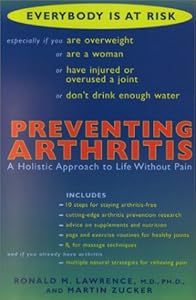
Cover of "Preventing Arthritis: A Holisti...
Cover via Amazon
2. Stretch those muscles

Any kind of stretching is good as long as you do not bounce, which can lead to a muscle pull. This is according to some of the professors of clinical medicine in New York City.

Try to hold a slow, steady stretch for 30 seconds to a minute, then relax and repeat. It is best to limber up by stretching before any exercise, especially running and walking. But it is also a good idea to stretch each day. Stretching lubricates and works your joints and keeps them in good working condition. Ask your doctor to teach you stretches that focus on potential arthritis trouble spots, such as the knees or the lower back.

3. Walking is one of the best and easiest forms of exercise

Take a good long walk at least three times a week or participate in a step-aerobics or low-impact exercise routine for maximum results. There is no proof that running is bad for the joints, but remember, it may aggravate an injury if you already have one. Just remember to check with your doctor before starting a new exercise program.

The bottom line is that of all the healthful habits, exercise is the most important. This is because people are designed to be active. Hence, it is really important for people to exercise in order to stay healthy and keep those joints well lubricated and free from wear and tear.

Just keep in mind that the unexercised body, even if currently free from symptoms of illness or problems like arthritis, is not at its full potential. Getting a fun, enjoyable and maintainable exercise program in place is one of the best things you can do for yourself this year!
Enhanced by Zemanta