Showing posts with label yoga benefits. Show all posts

Tuesday, September 17, 2013

Balance Your Life & Get Fit With Yoga

After a surge of interest during the consciousness-conscious '60s, yoga began to fall out of favor. Exercisers apparently lost patience with the activity, which offers slow but steady results, and turned to the fast pace and quick shape-up of aerobics. Now yoga is back - but less mystical than in the past, less reminiscent of gurus in pretzel positions, and more attractive than ever to people who are interested in working out rather than working toward some spiritual goal (although there are certainly many forms of yoga that can help with that as well).

People in various yoga asanas. Original title ...
People in various yoga asanas.  (Photo credit: Wikipedia)
Once you step out of the metaphysical, yoga is a great stretch and flexibility program. Yoga is increasingly being used by those who are having a trouble in balancing their work and personal life. A stressful working environment and a hectic schedule has an unhealthy impact on the personal lives of modern day executives and so many are turning to yoga to bring about peace of mind and a better work-life balance.

Also, many disgruntled runners, weight trainers and aerobic dancers complain that instead of reducing the stress in their lives, their exercise regimes add more.

People rush to work out every day at lunch, force themselves to keep up and then rush back to work. Although being active in just about any form has health benefits, in some ways these forced, fast-paced workouts are somewhat counterproductive. Yoga is less competitive, less stressful, and above all gives a wonderful feeling of well being.

Indeed, the healing aspects of yoga are key to its renewed popularity. The strained knees, aching backs and neck pains generated by the push for fitness and the stress of making it in a competitive world have inspired many to turn to yoga instead. Some orthopedic surgeons, chiropractors and neurologists are now referring patients to specific yogis during treatment.

Growing interest in the mind-body connection is fueling a major comeback of the ancient practice, boosted by research suggesting yoga can reduce stress and blood pressure, improve work performance, and even slow the effects of aging.

Several yoga techniques are now being taught in mainstream hospitals and businesses; books about them are brisk sellers and many discussion groups have sprung up on the Internet.

US Army 52844 Soldiers learn to connect mind, ...
US Army 52844 Soldiers learn to connect mind, body, soul through breathing (Photo credit: Wikipedia)
Even the Army is interested - it has asked the National Academy of Sciences to study meditation, yoga, and other new age techniques that might enhance soldiers' performance.

Details differ, but a common theme is relaxing the body while keeping the mind alert and focused - on an object, sound, breath or body movement. If the mind wanders - and it always does - you gently bring it back and start again. Yoga exercises include holding and/or moving through postures that tone and strengthen muscles throughout the entire body, while increasing flexibility and range of motion.

Stress-related problems and musculo-skeletal pain account for 60% to 90% of U.S. doctor visits, and mind-body approaches often are more effective, and cost-effective, than drugs or surgery. For example, in one study of people starting a regular yoga practice, 34% of infertile patients got pregnant within six months, 70% of insomniacs became regular sleepers, and doctor visits for pain are reduced by 36%.

Yoga can be a great addition to your exercise regimen, and can help balance your life in many different ways, which is of utmost importance in living a healthy, holistic lifestyle.

Visit our website for more on holistic living: http://www.newholisticliving.com/.

Enhanced by Zemanta

Tuesday, June 11, 2013

Yoga for Women: How to Gain a Shapely Waist through Yoga

The size of the waist is an indication of overall fitness for many people. Most health experts agree that a smaller waist is healthier than a big one. The reasoning behind this is that increases in fat around the waist and abdominal region usually result in increased health risks such as diabetes, high cholesterol and blood pressure.
In evolutionary and biological terms, a small waist signifies youth and vitality. But doing endless workouts of crunches alone will not allow you to achieve that Venus-like waist of your dreams. You will need to supplement specific waist-orientated exercises with ones from various disciplines.

Muscles of the trunk
Muscles of the trunk (Photo credit: Wikipedia)
Specifically you will need to work the inner girdle of muscles - commonly known as the core muscles - with slow abdominal exercises that work very deep into these muscle groups - and also incorporate some cardiovascular exercises that help your body shed fat.

While usually associated with building flexibility, some specific exercises from yoga-based workouts also target the underlying core muscles around the waist - and many can help with weight loss as well.

So, how can yoga help reshape your waist? In simple terms, by requiring you to move - and hold - your torso muscles as a unit. Rather than isolating your abdominal muscles as you do in crunches, yoga poses help to lengthen your overall torso, creating a feeling that is both centered and strong.

Think of your torso as a long vessel through which numerous muscles interact to keep you looking lean. Your transversus abdominis, the deepest abdominal muscle, works with the others to hold in your lower belly. Your erector spinae, the muscles that attach on your spine, straighten your posture and can make you feel (and appear) taller, while your rectus abdominis and obliques are the strong and flexible muscles that allow your limbs to move freely.

In holding most yoga poses, you are strengthening all of these muscles at once, without even thinking about it. This is one of the reasons I love yoga so much - it's a full-body workout, so that your whole body gets stronger as a unit, avoiding the imbalances that can often be caused by working muscles in isolation.

Here are a couple of great exercises for the abdominal and waist area to get you started:

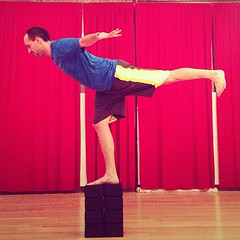
Warrior III Pose / Airplane on blocks #yoga #b...
Warrior III Pose / Airplane on blocks (Photo credit: TonyFelgueiras)
WARRIOR III POSE:

Start in the Mountain Pose with the heels slightly apart, big toes touching, legs straight, chest lifted, pelvis in a neutral position. Placing hands on hips, step back with your right foot so just your right toes touch the floor, keeping all of your body weight on your left foot.

Keep your right leg extended in a straight line as you start to lean forward from your hips. Balance the length of your body over your left leg until your torso is parallel to the floor. Keep your weight evenly distributed through inner and outer heel, with hips level. Begin with 5 breath cycles and progress to 15. As you get stronger, progress into the full pose by extending your arms up past your ears, so you are one long line from toes to fingertips.

Lift your torso up and return to the Mountain Pose; repeat on the other side.

PLANK POSE, INTO SIDE-PLANK POSE:

Plank!
Plank! (Photo credit: lululemon athletica)
Begin on your hands and knees, hands directly under shoulders, knees under hips. Move feet back until the legs are straight and you're balancing on your toes, feet together. Keep the shoulders pulled back and down, arms straight. This is the Plank Pose.

Squeezing the ankles together, roll onto the outer edge of the left foot, keeping feet stacked, legs straight. Lift the right hand toward ceiling then look up at it. Let your abs support your body without bending or crunching. Then lower right hand to floor, rolling down toward the right, and return to the Plank Pose. Repeat on other side. Hold each pose for 5 breath cycles.

Enhanced by Zemanta

Thursday, February 14, 2013

How To Get The Most From Your Yoga Workout

Yoga is an ancient art that has been refined and modified by many great teachers across the ages.  It now can be found in many different styles and techniques, and different people may find different versions of Yoga more suitable for them.  This is because Yoga is a very personal exercise routine with strong emphasis on looking within oneself in order to achieve personal balance and wellbeing.  Regardless of which individual version of Yoga you practice there are a number of things that apply to Yoga universally rather than to individual branches of the discipline.  If you want to get the most from your Yoga sessions it will help to understand these things and integrate them into your Yoga routine.

Vitruvian Man by Leonardo da Vinci, Galleria d...
Vitruvian Man by Leonardo da Vinci, Galleria dell' Accademia, Venice (1485-90) (Photo credit: Wikipedia)
1. You will find that much of your time performing Yoga is spent in a sitting or lying position, however the beginning of a Yoga session is usually a standard standing pose.  The standing pose is the most natural position for a human to find themselves in, yet we spend remarkably little time practicing standing correctly.  If you begin your Yoga session with a standing pose you are free from the stress of having to take on an unaccustomed position and this allows you to focus on other fundamentals of the Yoga Discipline.  For instance you can concentrate on regulating your breathing and feeling the full healing benefits of each breath.   The standing pose is so natural to us that we don't need to pay it any conscious thought and can focus on our breath entering the body and flowing through us.  The standing pose is also beneficial to bringing the body into alignment and centering ourselves both physically and spiritually.  Leonardo Da Vinci produced a famous diagram showing the perfect symmetry of the human body when it is in it's natural standing pose and this position has always been the most natural for us to find our center and balance.

2. The bulk of a Yoga session is spent in placing our body in positions or poses that stretch and activate the body.  These poses are entered into gently and gradually so there is no risk of injury.  Many poses have a number of different levels so we can get more and more benefits from them as our body becomes more used to them.  This is perhaps best demonstrated by a simple forward stretch.  When a gym teacher tells a pupil to touch their toes the pupil is performing the same exercise whether they can reach forward and touch the floor or whether the stretch only goes as far as their knees.  The only difference is the level of incline. 

The forward stretch is also a perfect example of how the natural movements of Yoga are used outside of a Yoga class or session - in this case in stretching and warming up before sports or other physical activities.  Most children whose coaches take them through a stretching routine before a game of football have no idea that many of the poses are borrowed directly from a Yoga session.

PARK CIRCLE COMMUNITY YOGA
(Photo credit: GO INTERACTIVE WELLNESS)
3. The key to enjoying and benefiting from this main phase of the Yoga session is to pace it to your level.  As with the child who can only forward stretch to knee level, you do not need to perform the exercise at the highest level from the first time you experience it.  Find your comfort zone and then move a fraction beyond it.  Then each new session try and maintain that level and push a little further if possible. 

4. The end of a Yoga session is also an important stage.  This stage usually consists of a group of restoration and restorative poses and positions that are designed to allow the energy to flow back through your body.  A good Yoga session releases pent up energy in your body, and allowing this energy to flow freely to all parts of the body is a critical part of gaining the maximum benefits from Yoga.
Enhanced by Zemanta

Tuesday, February 12, 2013

4 Common Misunderstandings About Yoga

Yoga is a very popular form of exercise and spiritual balancing, but it is also very often misunderstood by a lot of people.  This is almost inevitable when you consider the incredible popularity of Yoga as a discipline and the many different strands that Yoga has.  Quite often people have experience with one type of Yoga but not another, and as such they will base their overall impression of Yoga on what they have seen.  It is like people basing their impression on Germans on the most famous German they know - Adolf Hitler, or more recently the portrayal of George Bush internationally as the only example of an American anyone knows.  The truth is that Yoga can be very different depending on who you learn it from and how they perceive Yoga.  This article looks at some of the common misconceptions.

yoga
(Photo credit: GO INTERACTIVE WELLNESS)
Misconception Number One:  Yoga Is a Form of Exercise.

Well yes it is, but so is walking.  I can walk from my couch to my table and I can hardly claim to have done my exercise for the day.  The truth is that exercise is just the beginning of what yoga is.  It's closer to a combination of exercise, physiotherapy, psychology and spirituality all rolled into one.  As you come to master Yoga you will need to become more and more mentally strong, and most importantly disciplined.  If you can discipline yourself to do regular Yoga sessions, and maintain your discipline to do each pose for the prescribed time, and do it properly, then you will naturally become a more disciplined and organized person.  For some people this transcends to a spiritual level because they are so efficient at clearing their thoughts while meditating.

Misconception Number Two:  Yoga is for Hippies.

As previously mentioned Yoga can be a very spiritual experience if you become good enough at clearing your thoughts and concentrating whilst performing the exercises.  But you certainly do not have to begin with any certain type of spiritual belief.  Yoga is about aligning the body and the mind and the spirit through achieving inner balance. What that means to you is probably going to depend entirely on what your beliefs already are.  For some people it will be a spiritually freeing experience, for others it will be an effective way of de-stressing and achieving a level of calmness of thought.  Still others will claim that these things are one and the same.

Misconception Number Three:  Yoga is a Fad.
Recently there have been some very hyped up Yoga courses making big claims about what Yoga can achieve.  These are easy to associate with other 'fad' exercise crazes.  However Yoga is not something new and is based on principles that are hundreds of years old which describe exercises and poses that were probably being performed for generations before that.  An individual style of Yoga may come and go, but as long as people are still stretching before a game of football then Yoga is still being used.

yoga
(Photo credit: GO INTERACTIVE WELLNESS)
Misconception Number Four:  Yoga Is Too Slow to Help Me Lose Weight/Gain Tone etc.

This one is way off the mark, but we have been somewhat trained by the weight-loss industry that weight loss, and toning our body is all about hours in the gym and fast high-impact exercise.  That's simply not true.  Yoga can help with weight loss and in particularly toning for a number of reasons.  Firstly the exercises, while low impact and performed either statically or slowly - are still exercises.  While you use them you are using your muscles, and in many cases you are using muscles and muscle groups that regular exercise programs ignore. Building these muscles will gradually increase your metabolism, so that you are actually burning more fat even while you're not working out.

The second way that Yoga can be of benefit in a weight loss program is that it will increase your mental strength and allow you to be more disciplined with your food consumption.  When it comes down to it, pure and simple, as probably everyone knows, excess weight is a result of excess eating and not enough physical exercise to burn off the intake of calories.  Have you ever noticed how some people can eat donut after donut and not put on any weight at all?  It seems unfair, but it's a natural result of the state of their body.  Usually these people will be quite 'sinewy' and this muscle allows them the metabolize food faster.  That's the third benefit of Yoga in weight loss - as your muscles develop your body will actually become more efficient at consuming foods and processing them into nutrients and waste.

Hopefully we have now done away with the various myths associated with Yoga.  Bottom Line: Yoga is pretty much what you make of it, and it can have a myriad of benefits for both body and mind.
Enhanced by Zemanta