Showing posts with label Injury. Show all posts

Tuesday, August 12, 2014

6 Tips To Minimize Your Chances of Injury During Weight Training

Weight training can be a great way to shed some excess fat, and transform your body from saggy to firm and toned.  This is best achieved with regular, scheduled workouts.

There are two main reasons why people stop doing their regular workouts: 

1. They lose the motivation to continue, which can be attributed to a number of factors.
2. They injure themselves too often. 

The good news is you have control over the first point listed above, as long as you have the desire to do some exercise - and you find a form of exercise you enjoy.  As for the second reason, although you cannot eliminate the chances of an injury, you can definitely take steps to reduce the risk of being injured during weight training. 

So what are some steps you can take to reduce the chances of being injured?

1. Seek Professional Advice 

Personal trainer assisting and correcting a cl...
Personal trainer assisting and correcting a client during a stretching exercise. (Photo credit: Wikipedia)
Assuming you are just starting a program, seek advice from a personal trainer.  He will guide you through a series of exercises to target the muscle groups you seek to improve.  He will also demonstrate the proper form, which will reduce the chances of hurting yourself. 

2. Concentrate

When you are about to do a set, focus on what the repetitions should look like.  Psych yourself up, and make the weights or the machine your focal point.  Do not be distracted by others around you. 

One of the worst things that can happen to you is to laugh at something when you are in the middle of a bench press, for example.  This is why people often listen to music with headphones while working out – it minimizes outside distractions.

3. Ask For Help

If you are pushing yourself to a new level, or even if you are just not sure that you will be able to get those last couple of reps in, ask someone to spot you through your set.  If you get in trouble, he'll be there to assist you. 

4. Know Your Limits

Do not lift beyond your ability.  When weight training, the tendency is to lift too much too quickly.  Lifting more than you can handle, creates several problems:
* It leads to poor form.
* There is a lack of controlled speed, which can lead to jerky or bouncy movements.
* You may unexpectedly go beyond your maximum range of motion.

Not only will the aforementioned points cause injury (especially the third point), but you will not be properly working out the muscles you wish to target. 

5. Stretch

Although there has been some controversy over the actual benefits of stretching before a workout to prevent injury, the general consensus is that joints and muscles should be thoroughly warmed up before lifting weights. 

A few minutes of cardio before a workout is advisable to help prevent injury.  And  although the jury is still out on whether or not stretching can help to prevent injury, regular stretching has one major benefit – it will increase your flexibility!  This is important for all ages. 

6. Stop

It is one thing to work through muscle stiffness, but you should not be working through pain.  If, on a lift, you feel that something is not right, or pain sets in, stop immediately.  Do not finish your set. 

In conclusion, when it comes to injury prevention during weight training, an ounce of prevention really is worth a pound of cure.  Using a common-sense approach with safeguards in place, will keep you on track toward your workout goals. 


Tuesday, June 10, 2014

Assessing & Improving Your Running Posture

Running may sound simple, but actually, there's more to it than you might think. How you run has a direct impact on how much energy you use when you run. It also affects your risk for potential injury. Improving your running posture and form can help you run further, faster, and easier.

Assessing Your Running Posture

This is a two or three step process. The first step is to pay attention to your posture on your next run. Here are some things to assess:

Giving my all:  poor posture!
Poor posture (Photo credit: midwestnerd)
* Are you bent at the waist, standing up straight or leaning forward from the hips?
* Are your shoulders scrunched up or relaxed?
* When you run up hill do you shorten your stride, lengthen your stride or keep it the same?
* When you swing your arms do they move parallel to your body? Do they swing in front of your body? Do they move at all?
* Do you clench your fists or are your hands relaxed?
* Is your chin tucked down, tipped toward the sky or looking straight ahead?

When you’re running try a few different things and see how it feels. For example, scrunch your shoulders then relax them. What feels different? Now lean forward at the waist and run for a minute. Now straighten and run for a minute. Now lean forward at the hips and run for a minute. How did each change feel? How did it affect your running and your effort level?

Now it can be difficult to assess your posture by yourself. The next step is to ask a friend to video tape you running. Try to run naturally without making any changes or adjustments. Tape yourself for a few minutes. When you review the video you can assess yourself based on the questions listed above.

POSITION OF SKELETON IN GOOD AND POOR POSTURE ...
POSITION OF SKELETON IN GOOD AND POOR POSTURE -  (Photo credit: Wikipedia)
What to Aim For

Ideally, your upper body including your shoulders, arms and hand will be relaxed. Your arms will move from side to side and match your stride. If they cross your body it causes your torso to rotate which takes energy. This energy is better spent in your legs.

Imagine a string running from the top of your head down to the center of your belly. This string keeps your head, neck and back in alignment. When you need to increase your speed, lean forward from the hips just a touch. You’ll notice that you gain momentum by changing gravity here. Stand up straight and you slow down. Think about how you run when you’re going downhill, you automatically lean back bit right? And when you’re running uphill you lean forward. It’s a natural instinct. Make sure you’re leaning from the hips instead of your waist for maximum efficiency.

Finally, your feet will ideally stay under you. If your leg reaches too far forward it causes your heel to strike the ground first. This impact can cause injury to your knees, shins, and hips. This may mean you need to start with a shorter stride. You can make up the speed by increasing your turnover or the number of steps you take in a specific amount of time.

Good posture makes a huge difference in the amount of energy you expend when you run. The more efficiently you can run the less energy it takes to complete a run. It may take time to correct your posture but it’s worth it - less effort, better results and fewer injuries.
Enhanced by Zemanta

Tuesday, June 4, 2013

Runner's Exercises for Your Off Days

Many runners like to run as often as possible, and some might even run every single day if they could. But most know that they need to take at least one or two days off from running each week to keep themselves fresh and injury free. So what’s the best way to work out, or even simply be active, during those “off days” from running?

Muscles of the gluteal and posterior femoral r...
Muscles of the gluteal and posterior femoral regions. (Photo credit: Wikipedia)
One popular approach is to find an activity or workout which uses muscles that aren’t the primary running muscles. This concept is often referred to as “cross-training.” For example, some runners will head to the pool and swim laps on their off days, which gives them an upper body and aerobic workout, while allowing their leg muscles to rest somewhat. Even some activities that rely heavily on the leg muscles, such as bicycling, can be considered cross-training for runners because they involve a different motion and use different muscles within the leg than running does.

Another approach is to forego the aerobic activities altogether on the off days and focus on strength and flexibility. Because of the repetitive nature of running, many runners suffer from muscle imbalances that can lead to an increased risk of injury. By dedicating time to exercises that strengthen core muscles, for example, runners can maintain better posture as they get tired later in their runs, which will keep them faster and help them avoid injury.

Many runners also suffer from chronic tightness in their leg muscles. Over time, muscle tightness can lead to poor form and increased injuries. Stretching exercises can help to open up muscle tissues and allow the body to keep its optimal position when it comes time to run.

Pilates is one great way to combine the beneficial effects of stretching and strengthening in a single routine. Pilates can either be done at home as a floor-based exercise (there are numerous instructional DVDs that you can use to learn various Pilates workouts), or you can take Pilates classes at a gym and use a specialized piece of Pilates equipment called a “reformer.” Yoga also makes a great off-day workout for runners.

Curso de Instructor de Pilates
Pilates (Photo credit: Wikipedia)
Much of what you do during your off day should depend on what you did yesterday and what you’re planning to do tomorrow. For example, if you normally take a day off after your “long run” (whatever length run that may be), then you should ensure that the non-running exercises you do give your body sufficient opportunity to heal from the running workout the day before. By the same token, if you normally take a day off before you do your long run, then don’t do any cross-training or other exercises that would make it too difficult to complete your long run workout on the next day.

Finding the appropriate exercise for your off days will involve a bit of experimentation. You can look to other runners for ideas on what exercises make sense, but ultimately you’ll need to try them out to see how they actually work for you.

Check back here tomorrow for a fun off-day workout.

Enhanced by Zemanta

Tuesday, April 23, 2013

Running Safety: 5 Tips for Injury Protection

Let’s start off by saying that running is a safe and generally injury-free sport. It’s not a contact sport. Additionally, unlike skiing or even cycling, a runner can usually safely come to a stop. That being said, as with any physical activity there are risks of injury. Fortunately, most running injuries can be prevented with a little attention and forethought.

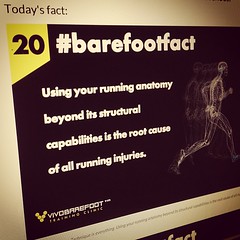
Technique is everything  #barefootfact 20 Usin...
Using your running anatomy beyond its structural capabilities is the root cause of all running injuries. (Photo credit: VIVOBAREFOOT)
Tip #1: Don’t Push It.

One of the most common causes for running injuries is overuse. When you run too far, too fast, too many times you push your body beyond what it can handle and it rewards you with an injury. Common overuse injuries include muscle strains and sprains, joint pain like runner’s knee or shin splints, and sprained ankles and knees. You can even suffer from stress fractures in the bones of your feet, ankles and legs from overuse.

Tip #2: Avoid Dehydration

Cramps, side stitches, and abdominal distress are all caused by dehydration. Let your body become too dehydrated and you can also suffer from heart, lung, and muscle damage. Drink! Make sure you take in at least 4 ounces of water every fifteen minutes if you’re running for more than thirty minutes. And the warmer it is, the more you should drink.

Tip #3: Watch Where You’re Going
It may sound simplistic, but many injuries are caused by good old fashioned clumsiness. We’re talking about sprained ankles, broken bones, and torn cartilage. If you’re running in the dark, carry a flashlight or run in a well lit area. Running on trails? Watch where you’re going. The same goes for running on the sidewalk or in the road.

Tip #4: Wear Good Shoes (and socks)

Blisters are often the result of your shoes, or socks, causing friction on your foot. If you get blisters often try different types of socks. Wool socks often work well because they wick moisture away from your foot.

Make sure you have good shoes on too. Your shoes should correct for any foot strike issues and mechanics. Ideally, with the right shoe, your foot will strike the pavement head on and not roll to the inside or outside. When your foot rolls one direction or the other it puts unnatural stress on your joints, bones, and ligaments.

Rick Finishes The Watermelon Run
 (Photo credit: chuckwaters83)
Tip #5: Pay Attention to Your Running Form

When you run do you lean forward at the waist? Do you swing your arms across your body? Do you take long strides and strike the ground with your heel? Each movement your body makes either makes running feel natural and easier or unnatural and harder. The trouble is that if you’ve been running or moving one way for a while it’s difficult to know if it’s the right way. Ask someone to watch you run or better yet, have them video tape you so you can see your running form. The optimal running form usually has a shorter stride, good posture and a nice relaxed arm swing that keeps your arms at your sides. Watch other runners to view their posture so you can begin to get a comparison.

There comes a time in most runners’ lives when they forget one of these five tips and suffer an injury. Hopefully, you won’t be one of those runners. There’s something to be said for an injury-free experience.

Enhanced by Zemanta

Thursday, February 21, 2013

Weight Training for Children - Important Things to Consider

It's great if your child loves to exercise, but what if you have a younger child of 6 to 8 years old that wants to participate in more adult activities, such as lifting weights?  While some think it is perfectly fine for children to lift weights, there are others that think differently.

English: Osgood-Schlatter disease. Lateral rad...
Osgood-Schlatter disease. Lateral radiograph of the knee demonstrating fragmentation of the tibial tubercle (see inset) with overlying soft tissue swelling. (Photo credit: Wikipedia)
The long and short of it is that while it can be very beneficial for your child to partake in a weight training regimen, there are a few things that you should keep in mind.

No matter how you look at it, children aren't miniature adults and therefore you can't use the same methods with growing children that you can use with adults, as children are different from adults emotionally, anatomically, and physiologically.

All children have immature skeletons, as their bones don't mature until somewhere between 14 - 22 years of age.  With girls, exercise (or the lack of it) during childhood can have very critical effects on bone health that can last for their entire lives.

Children are often times vulnerable to growth related overuse injuries such as Osgood Schlatter disease.  Children also have immature temperature regulation systems due to their having a large surface area compared to their muscle mass which will cause them to be more susceptible to injury when they aren't properly warmed up.

Children don't sweat as much as adults do, so they will be more susceptible to heat exhaustion as well as a heat stroke and dehydration.  Due to their low muscle mass and immature hormone system, it makes it harder for them to develop strength and speed. Their breathing and heart response during exercise are also different from an adult's, which will affect their capacity for exercise.

On the other hand, young boys and girls can drastically improve their strength with weight training although opposed to adults, neurological factors instead of muscle growth factors are mostly responsible.

When you consider weight training programs for children, first and foremost you should obtain a medical clearance from your child's pediatrician.  The first approach to designing a program is to establish a repetition range of 8 - 12 and keep the work load appropriate for the range, as well as the age, size, and strength of your child.

The weight stack from a cable machine: each pl...
 (Photo credit: Wikipedia)
You should ensure that workouts are spread out enough to have at least 1 - 2 full days of rest between sessions. The main focus when working out should be on the form of every exercise performed, and not on the amount of weight being lifted. Proper technique is important for everyone when working out, but especially children, whose smaller growing frames can be especially adversely affected by injury. Teaching the importance of proper form and technique while young will also carry over into adulthood, and give them a sense of responsibility and control over their own bodies.

Before weight training, be sure your child does a proper warmup including stretching to avoid injury.  Start your child off with light loads and then make adjustments accordingly.  No more than 3 non-consecutive weight sessions should be done in a week.  You should also see to it that they drink plenty of water before, during, and after exercise.  Getting enough water is very important with exercise, as it is often very easy to get dehydrated - especially with children who have smaller bodies that hold less water.

If you follow these important tips, your child can definitely benefit from incorporating some weight training into their activities. It can help them build strong bones for life, balance out their musculature, and promote increased self esteem and independence - all these are great benefits that will help them grow into healthy adulthood.
Enhanced by Zemanta

Tuesday, October 16, 2012

Runner's Safety: 5 Tips for Injury Protection

Let’s start off by saying that running is a safe and generally injury free sport. It’s not a contact sport. Additionally, unlike skiing or even cycling, a runner can usually safely come to a stop. That being said, as with any activity there are risks of injury. Fortunately, most running injuries can be prevented with a little attention and forethought.

Tip #1:  Don’t Push It

Injury Prevention
Injury Prevention (Photo credit: Army Medicine)
One of the most common causes for running injuries is overuse. When you run too far, too fast, too many times you push your body beyond what it can handle and it rewards you with an injury. Common overuse injuries include muscle strains and sprains, joint pain like runner’s knee or shin splints, and sprained ankles and knees. You can even suffer from stress fractures in the bones of your feet, ankles and legs from overuse.

Tip #2:  Stay Hydrated

Cramps, side stitches, and abdominal distress are all caused by dehydration. Let your body become too dehydrated and you can also suffer from heart, lung, and muscle damage. Drink! Make sure you take in at least a few ounces of water every fifteen minutes if you’re running for more than thirty minutes. And the warmer it is, the more you should drink.

Tip #3: Watch Where You’re Going

Many injuries are caused by good old fashioned clumsiness. We’re talking about sprained ankles, broken bones, and torn cartilage. If you’re running in the dark, carry a flashlight or run in a well lit area. Running on trails? Watch where you’re going. The same goes for running on the sidewalk or in the road.

mild 2nd degree sprain, rotated inwards.
Mild 2nd degree sprain, rotated inwards. (Photo credit: Wikipedia)
Tip #4: Wear Good Shoes (and Socks)

Blisters are often the result of your shoes, or socks, causing friction on your foot. If you get blisters often try different types of socks. Wool socks often work well because they wick moisture away from your foot.

Make sure you have good shoes on too. Your shoes should correct for any foot strike issues and mechanics. Ideally, with the right shoe, your foot will strike the pavement head on and not roll to the inside or outside. When your foot rolls one direction or the other it puts unnatural stress on your joints, bones, and ligaments.

Tip #5: Pay Attention to Your Running Form

When you run do you lean forward at the waist? Do you swing your arms across your body? Do you take long strides and strike the ground with your heel? Each movement your body makes either makes running feel natural and easier or unnatural and harder. The trouble is that if you’ve been running or moving one way for a while it’s difficult to know if it’s the right way. Ask someone to watch you run or better yet, have them video tape you so you can see your running form. The optimal running form usually has a shorter stride, good posture and a nice relaxed arm swing that keeps your arms at your sides. Watch other runners to view their posture so you can begin to get a comparison.

There comes a time in most runners’ lives when they forget one of these five tips and suffer an injury. Hopefully, you won’t be one of those runners. There’s something to be said for an injury-free running experience - it makes it a lot more fun.

Enhanced by Zemanta

Thursday, September 20, 2012

5 Steps to Getting Started With Barefoot Running

Ready to try out the latest running trend? If you have struggled with running pain or are just curious about the hype then barefoot running may be something to try. Before you take off your shoes and head out the door it’s important to know the facts. It’s important to get started correctly or you may get hurt.

Healthy feet of an 11-year-old girl who regula...
Healthy feet of an 11-year-old girl who regularly goes barefoot. Note the presence of ideal arches. (Photo credit: Wikipedia)
Step #1: Start Walking Barefoot First

The first step is to start acclimating your feet to being without shoes. Start walking barefoot whenever you can. Walk barefoot around the house, in the park or your yard. You may also want to consider buying a pair of minimal walking shoes. These shoes have a large toe box which gives your toes room to spread out. They also don’t provide any cushioning for your feet. And they’ll have little if any height difference between your heel and your toe. They’re flat.

Step #2: Walk Outside Barefoot for 10 Minutes a Day

The next step is to begin to toughen your feet and strengthen them. Yes, you have muscles in your feet. Now you may be tempted to run at this point. Don’t do it. Spend a week walking outside each day for ten minutes. Walk on the grass. Walk on the sidewalk. Feel the ground beneath your feet and pay attention to how you may walk differently – lighter.

Step #3: Increase Your Walking Time

Start increasing your walking time to fifteen minutes each day and try to transition from the grass or sand to the concrete or asphalt. At this point you may start running for no more than five minutes on grass. Stay off the pavement.

Step #4: Start Running

Assuming your feet are doing okay, minimal aches and pains, you can begin to transition to running on pavement with your bare feet. Again, you may want to keep it to less than five minutes. You can also alternate between running and walking.

English: Vibram FiveFingers Bikila shoes, top ...
Vibram FiveFingers Bikila shoes, top view. (Photo credit: Wikipedia)
Step #5: Building Your Endurance

Gradually increase the amount of time you can run with bare feet. You’ll probably want to run no more than three or four days a week. Your feet will need a rest.

What About Minimal Shoes?

This step by step schedule is designed for people running barefoot or with minimal shoes. If you’re wearing something like the Five Fingered shoes from Vibram (see our review of these in Saturday's post) then you will still want to take it slowly. You may, however, be able to hit the pavement sooner but take care. If you feel any significant aches or pains, take it down a notch. You’ve been wearing shoes for decades; it takes time for your feet to adjust to feeling and responding with the ground in this new form.


Enhanced by Zemanta

Tuesday, September 18, 2012

Barefoot Running: Why You Should Try It

It seems that everyone and their brother are trying out the latest running craze. It’s called barefoot running. And while many barefoot runners don’t actually run without any foot protection, the shoes they wear are minimal. Proponents of bare foot running say that it has alleviated their running pain.

English: barefoot running
Barefoot running (Photo credit: Wikipedia)
They claim to be able to run better without traditional running shoes and there is a lot of evidence to support this. We weren’t born with shoes on after all and a running shoe does alter the way your foot hits the ground. Much like wearing high heels, traditional running shoes elevate the heel and may cause more harm than good.

Reasons to Consider Barefoot Running
There are two main reasons why people try and often prefer to run barefoot (or with minimal shoes). These reasons include:

1. Less Risk of Injury

When you run as your body was meant to run, that is without a shoe altering the movement of your feet and legs, you move naturally. This reduces your risk of injury. Additionally, when you run barefoot you will notice almost immediately that your foot hits the ground differently.

Your foot will strike at the midfoot, instead of hitting your heel first and rolling through you’ll hit more flat footed. You will also run with shorter strides and you’ll run more lightly. All of these changes reduce your risk of injury. The muscles in your ankles and feet become stronger too which means they can handle more when you run. You’ll be able to run further and faster without injury.

English: An example of a barefoot runner in a ...
An example of a barefoot runner in a 5K race. (Photo credit: Wikipedia)
2. It’s Fun!

The other reason is that many find running barefoot to be more fun. Think about how the grass or sand feels on your feet. For most, this is a good feeling. Running barefoot enables you to begin to experience the world through your feet. It’s almost like wearing gloves all of your life and then taking them off to feel the world around you with your hands for the first time! It’s a lovely sensory experience.

Before You Run
It’s important to start slow if you’re considering barefoot running. In fact, most experts recommend walking barefoot around your home and in your yard first. You need to build the muscles in your feet and acclimate your feet to the rough textures on the ground first. You may also be happy to know that barefoot running doesn’t make your feet look ugly. In fact, most barefoot runners don’t have calloused or hard feet. Their feet look natural and soft.

If you’re interested in trying barefoot running, you may also consider starting with a pair of minimalist shoes. You’ll still want to start slowly and strengthen your feet; however you may be able to get on the road faster with a little protection.

Be sure to check back Thursday for some helpful tips for getting started with this fun form of exercise!

Or Check Out These Helpful Guides:
   

Enhanced by Zemanta

Tuesday, July 3, 2012

10 Things You Should Know About Stretching

Before fitness training of any kind, it is very important to do warm-up or stretching exercises to prevent accidents or injury, and enhance the benefits you will gain from your exercise session.  There are also a number of precautionary measures and tips that may serve as guidelines when getting ready to work out.

Here are 10 helpful tips:

English: An elderly at stretching exercises in gym
English: An elderly man performs stretching exercises in gym (Photo credit: Wikipedia)
1.  To increase your flexibility and to avoid injuries, stretch before and after a workout.  Almost everyone knows that stretching before workouts prevents injuries during the exercises, but stretching after a workout, when muscles are still warm, can also increase flexibility and reduce soreness.

2.  Hold your stretching position for at least 60 seconds to increase flexibility.  While holding your position for 20 seconds might be enough for warm ups, holding each position for at least 60 seconds will improve the body's flexibility a lot more. Also don't bounce while holding stretches (see next tip).

3.  Do not repeatedly go into a stretching position then immediately return to the relaxed position.  This is more appropriately termed as bouncing. When stretching, hold that position for several seconds (see #2 above), and then slowly relax.  You may do this exercise repeatedly this way.  Bouncing or forcing yourself into a position during stretching can strain or damage some joints or muscles.

4.  Work slowly in increments instead of immediately proceeding to doing the hardest exercise or position.

5.  Make sure that you have stretched or warmed up all muscle groups.  For some people, even if they have strong bodies, they tend to neglect the neck when working out of stretching.  Stretching the neck muscles can be as simple as placing the palm of one's hand against the front of the head and pushing it as far as it will comfortably go.  Then, do the same to the sides and the back of the head.

6.  Stretch regularly to continually increase your range of movements and your level of flexibility and strength.

7.  Work out considering only your capabilities and not of others.  Do not force yourself to do exercises that you are not yet capable of just because there are people who can do it.  Increase your limits slowly.  Listen to your body.  There are days when your body may be too tired and you may have to consider reducing your range of motion. This is fine, and it's better to take it easy for a day or two than to injure yourself.

8.  Learn to rest.  Rest in between sets and stations to make sure that the body has enough time to recover its energy.  Also, it is advisable that you don't work the same muscle groups consecutively for two days.  The muscles actually grow in strength during the period when you rest and not when you are working out.

9.  Do aerobic exercises in intervals to strengthen your heart.  Aerobic exercises are those physical activities that use oxygen for fuel.  This includes cardiovascular exercises such as skipping rope, running or swimming.

10.  Music may help you when you want to train for longer periods or to increase your intensity.  You can use mp3 players, CD players or lightweight am radio receivers for this.  Just make sure that you brought your headset with you if working out in public so you wouldn't disturb people who don't prefer music while exercising.

Apart from preventing injuries and increasing one's flexibility, many people also find that stretching feels good for a tired body and helps relax your mind as well.
Enhanced by Zemanta

Tuesday, February 1, 2011

Why Muscles Get Sore

If you've been trying out strength training like we discussed last week, or just trying to stay motivated to keep exercising this winter, you may hit a wall that slows you down and threatens to derail your routine, despite your good intentions: sore muscles.

As people age, we usually begin to experience more pains in our muscles and joints. They seem to stiffen up with age, and such commonplace activities as bending over for the morning paper can cause stiffness or even severe pain.

Collage of several of Gray's muscle pictures, ...Image via WikipediaSuch pain can grip so fiercely that we might think it begins deep in our bones. But the real cause of stiffness and soreness lies not in the joints or bones, according to research at the Johns Hopkins Medical School, but more often in the muscles and connective tissues that move the joints. Actually, the frictional resistance generated by the two rubbing surfaces of bones in the joints is negligible, even in joints damaged by arthritis.

It has more to do with flexibility. Flexibility is the medical term used to describe the range of a joint’s motion from full movement in one direction to full movement in the other. The greater the range of movement, the more flexible the joint.

If you can bend forward at the hips and touch your toes with your fingertips, you have good flexibility, or range of motion of the hip joints. But can you bend over easily with a minimal expenditure of energy and force? The exertion required to flex a joint is just as important as its range of possible motion.

Different factors limit the flexibility and ease of movement in different joints and muscles. In the elbow and knee, the bony structure itself sets a definite limit. In other joints, such as the ankle, hip, and back, the soft tissue—muscle and connective tissue—limit the motion range.

The problem of inflexible joints and muscles is similar to the difficulty of opening and closing a gate because of a rarely used and rusty hinge that has become balky.

Hence, if people do not regularly move their muscles and joints through their full ranges of motion, they lose some of their potential. That is why when these people will try to move a joint after a long period of inactivity, they feel pain, and that discourages further use

What happens next is that the muscles become shortened with prolonged disuse, and attempted use  then produces spasms and cramps that can be irritating or even extremely painful. The immobilization of muscles, as researchers have demonstrated with laboratory animals, brings about biochemical changes in the tissue.

However, other factors can also trigger sore muscles. Here are some of them:

1. Too much (or too strenuous) exercise

Have you always believed on the saying, “No pain, no gain?” If you do, then, it is not so surprising if you have already experienced sore muscles.

The problem with most people is that they exercise too much all at once thinking that it is the fastest and the surest way to lose weight. Until they ache, they tend to ignore their muscles and connective tissue, even though they are what quite literally holds the body together. Then, the pain causes them to stop exercising, or they injure themselves, thus being unable to exercise for period of time, during which the stiffness and inflexibility sets in as described above. It can really become a vicious cycle, unless you are careful not to overdo it.

2. Aging and inactivity

Connective tissue binds muscle to bone by tendons, binds bone to bone by ligaments, and covers and unites muscles with sheaths called fasciae. With age, the tendons, ligaments, and fasciae become less extensible. The tendons, with their densely packed fibers, are the most difficult to stretch. The easiest are the fasciae. But if they are not stretched to improve joint mobility, the fasciae shorten, placing undue pressure on the nerve pathways in the muscle fasciae. Many aches and pains are the result of nerve impulses traveling along these pressured pathways.

3. Immobility

Sore muscles or muscle pain can be excruciating, owing to the body’s reaction to a cramp or ache. In this reaction, called the splinting reflex, the body automatically immobilizes a sore muscle by making it contract. Thus, a sore muscle can set off a vicious cycle pain.

First, an unused muscle becomes sore from exercise or being held in an unusual position. The body then responds with the splinting reflex, shortening the connective tissue around the muscle. This causes more pain, and eventually the whole area is aching. One of the most common and debilitating sites for this problem is the lower back. (For some very helpful tips on healing and preventing back pain, visit http://www.losethebackpain.com.)

4. Spasm theory


In the physiology laboratory at the University of Southern California, some people have set out to learn more about this cycle of pain.

Using a special device, they measured electrical activity in the muscles. The researchers knew that normal, well-relaxed muscles produce no electrical activity, whereas, muscles that are not fully relaxed show considerable activity.

Adipose tissue is one of the main types of con...Image via WikipediaIn one experiment, the researchers measured these electrical signals in the muscles of persons with athletic injuries, first with the muscle immobilized, and then, after the muscle had been stretched. In almost every case, exercises that stretched or lengthened the muscle diminished electrical activity and relieved pain, either totally or partially.

These experiments led to the “spasm theory,” an explanation of the development and persistence of muscle pain in the absence of any obvious cause, such as traumatic injury.

According to this theory, a muscle that is overworked or used in a strange position becomes fatigued and as a result, sore muscles (or even lasting, chronic pain).

Hence, it is extremely important to know the limitations and capacity of the muscles in order to avoid sore muscles. This goes to show that there is no truth in the saying, “No pain, no gain.” What matters most is on how people stay fit by exercising regularly at a normal range, rather than once in a while at a strenuous level.

To stick to your exercise goals, and find new ways to have fun and stay motivated, keep checking this blog, or visit http://www.newholisticliving.com/exercise.html.

Enhanced by Zemanta