Functional fitness can be thought of as working out for "real-life" situations. You prepare your body to allow you to do the normal things that you do, day in and day out. This is the reason that most people want to be fit in the first place. Not everyone wants to exercise so they can run marathons and compete in weightlifting tournaments. Most people just want to be strong and healthy enough to live their life and go about their daily routine.
The Mayo Clinic, a globally recognized health authority, defines functional fitness as:
"Exercises that train your muscles to work together and prepare them for daily tasks by stimulating common movements you might do at home, at work or in sports. While using various muscles in the upper and lower body at the same time, functional fitness exercises also emphasize core stability."
You will see that the Mayo Clinic mentions core stability. Your core group of muscles include several muscle groups. Their number one job is to protect your spine. They are also vital for proper balance and mobility. Functional fitness exercises often target your core, since a healthy core is so important for performing everyday tasks.
How Can Functional Fitness Benefit You?
Why do you want to be stronger and healthier? Think about your answers to that question. If you live to exercise, functional fitness is probably not all that interesting to you. However, if you just want to become fit so you can effortlessly play with your kids or grandchildren, unload your groceries or enjoy a walk with a friend without getting tired and worn down, functional fitness is ideally suited to your goals.
A simple squat is an example of a functional exercise that works multiple muscle groups. It also mimics daily movements that you make, such as getting out of a chair or squatting down to pick something up off of the floor. Lunges, standing bicep curls and simple step-ups with weights are a few other types of functional exercises. Kettle bells and dumbbells can be used to accentuate your functional exercise routine, but are not required.
Body weight exercises which require no weights are excellent examples of functional exercises. A search for "functional exercises" on YouTube will give you some free video training about exactly how to perform these body strengthening, health enhancing maneuvers - and of course check this blog regularly, as we often share great bodyweight workouts for free! There are also books and DVDs available at online retail outlets like Amazon.com which deliver the everyday benefits of functional exercise.
Showing posts with label avoid injury. Show all posts
Showing posts with label avoid injury. Show all posts
Tuesday, June 28, 2016

Tuesday, August 12, 2014
6 Tips To Minimize Your Chances of Injury During Weight Training
Weight training can be a great way to shed some excess fat, and transform your body from saggy to firm and toned. This is best achieved with regular, scheduled workouts.
There are two main reasons why people stop doing their regular workouts:
1. They lose the motivation to continue, which can be attributed to a number of factors.
2. They injure themselves too often.
The good news is you have control over the first point listed above, as long as you have the desire to do some exercise - and you find a form of exercise you enjoy. As for the second reason, although you cannot eliminate the chances of an injury, you can definitely take steps to reduce the risk of being injured during weight training.
So what are some steps you can take to reduce the chances of being injured?
1. Seek Professional Advice
Assuming you are just starting a program, seek advice from a personal trainer. He will guide you through a series of exercises to target the muscle groups you seek to improve. He will also demonstrate the proper form, which will reduce the chances of hurting yourself.
2. Concentrate
When you are about to do a set, focus on what the repetitions should look like. Psych yourself up, and make the weights or the machine your focal point. Do not be distracted by others around you.
One of the worst things that can happen to you is to laugh at something when you are in the middle of a bench press, for example. This is why people often listen to music with headphones while working out – it minimizes outside distractions.
3. Ask For Help
If you are pushing yourself to a new level, or even if you are just not sure that you will be able to get those last couple of reps in, ask someone to spot you through your set. If you get in trouble, he'll be there to assist you.
4. Know Your Limits
Do not lift beyond your ability. When weight training, the tendency is to lift too much too quickly. Lifting more than you can handle, creates several problems:
* It leads to poor form.
* There is a lack of controlled speed, which can lead to jerky or bouncy movements.
* You may unexpectedly go beyond your maximum range of motion.
Not only will the aforementioned points cause injury (especially the third point), but you will not be properly working out the muscles you wish to target.
5. Stretch
Although there has been some controversy over the actual benefits of stretching before a workout to prevent injury, the general consensus is that joints and muscles should be thoroughly warmed up before lifting weights.
A few minutes of cardio before a workout is advisable to help prevent injury. And although the jury is still out on whether or not stretching can help to prevent injury, regular stretching has one major benefit – it will increase your flexibility! This is important for all ages.
6. Stop
It is one thing to work through muscle stiffness, but you should not be working through pain. If, on a lift, you feel that something is not right, or pain sets in, stop immediately. Do not finish your set.
In conclusion, when it comes to injury prevention during weight training, an ounce of prevention really is worth a pound of cure. Using a common-sense approach with safeguards in place, will keep you on track toward your workout goals.
There are two main reasons why people stop doing their regular workouts:
1. They lose the motivation to continue, which can be attributed to a number of factors.
2. They injure themselves too often.
The good news is you have control over the first point listed above, as long as you have the desire to do some exercise - and you find a form of exercise you enjoy. As for the second reason, although you cannot eliminate the chances of an injury, you can definitely take steps to reduce the risk of being injured during weight training.
So what are some steps you can take to reduce the chances of being injured?
1. Seek Professional Advice
 |
| Personal trainer assisting and correcting a client during a stretching exercise. (Photo credit: Wikipedia) |
2. Concentrate
When you are about to do a set, focus on what the repetitions should look like. Psych yourself up, and make the weights or the machine your focal point. Do not be distracted by others around you.
One of the worst things that can happen to you is to laugh at something when you are in the middle of a bench press, for example. This is why people often listen to music with headphones while working out – it minimizes outside distractions.
3. Ask For Help
If you are pushing yourself to a new level, or even if you are just not sure that you will be able to get those last couple of reps in, ask someone to spot you through your set. If you get in trouble, he'll be there to assist you.
4. Know Your Limits
Do not lift beyond your ability. When weight training, the tendency is to lift too much too quickly. Lifting more than you can handle, creates several problems:
* It leads to poor form.
* There is a lack of controlled speed, which can lead to jerky or bouncy movements.
* You may unexpectedly go beyond your maximum range of motion.
Not only will the aforementioned points cause injury (especially the third point), but you will not be properly working out the muscles you wish to target.
5. Stretch
Although there has been some controversy over the actual benefits of stretching before a workout to prevent injury, the general consensus is that joints and muscles should be thoroughly warmed up before lifting weights.
A few minutes of cardio before a workout is advisable to help prevent injury. And although the jury is still out on whether or not stretching can help to prevent injury, regular stretching has one major benefit – it will increase your flexibility! This is important for all ages.
6. Stop
It is one thing to work through muscle stiffness, but you should not be working through pain. If, on a lift, you feel that something is not right, or pain sets in, stop immediately. Do not finish your set.
In conclusion, when it comes to injury prevention during weight training, an ounce of prevention really is worth a pound of cure. Using a common-sense approach with safeguards in place, will keep you on track toward your workout goals.
Tuesday, April 23, 2013
Running Safety: 5 Tips for Injury Protection
Let’s start off by saying that running is a safe and generally injury-free sport. It’s not a contact sport. Additionally, unlike skiing or even cycling, a runner can usually safely come to a stop. That being said, as with any physical activity there are risks of injury. Fortunately, most running injuries can be prevented with a little attention and forethought.
Tip #1: Don’t Push It.
One of the most common causes for running injuries is overuse. When you run too far, too fast, too many times you push your body beyond what it can handle and it rewards you with an injury. Common overuse injuries include muscle strains and sprains, joint pain like runner’s knee or shin splints, and sprained ankles and knees. You can even suffer from stress fractures in the bones of your feet, ankles and legs from overuse.
Tip #2: Avoid Dehydration
Cramps, side stitches, and abdominal distress are all caused by dehydration. Let your body become too dehydrated and you can also suffer from heart, lung, and muscle damage. Drink! Make sure you take in at least 4 ounces of water every fifteen minutes if you’re running for more than thirty minutes. And the warmer it is, the more you should drink.
Tip #3: Watch Where You’re Going
It may sound simplistic, but many injuries are caused by good old fashioned clumsiness. We’re talking about sprained ankles, broken bones, and torn cartilage. If you’re running in the dark, carry a flashlight or run in a well lit area. Running on trails? Watch where you’re going. The same goes for running on the sidewalk or in the road.
Tip #4: Wear Good Shoes (and socks)
Blisters are often the result of your shoes, or socks, causing friction on your foot. If you get blisters often try different types of socks. Wool socks often work well because they wick moisture away from your foot.
Make sure you have good shoes on too. Your shoes should correct for any foot strike issues and mechanics. Ideally, with the right shoe, your foot will strike the pavement head on and not roll to the inside or outside. When your foot rolls one direction or the other it puts unnatural stress on your joints, bones, and ligaments.
Tip #5: Pay Attention to Your Running Form
When you run do you lean forward at the waist? Do you swing your arms across your body? Do you take long strides and strike the ground with your heel? Each movement your body makes either makes running feel natural and easier or unnatural and harder. The trouble is that if you’ve been running or moving one way for a while it’s difficult to know if it’s the right way. Ask someone to watch you run or better yet, have them video tape you so you can see your running form. The optimal running form usually has a shorter stride, good posture and a nice relaxed arm swing that keeps your arms at your sides. Watch other runners to view their posture so you can begin to get a comparison.
There comes a time in most runners’ lives when they forget one of these five tips and suffer an injury. Hopefully, you won’t be one of those runners. There’s something to be said for an injury-free experience.

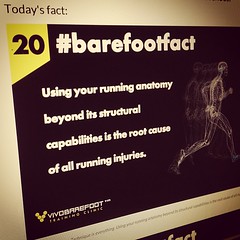 |
| Using your running anatomy beyond its structural capabilities is the root cause of all running injuries. (Photo credit: VIVOBAREFOOT) |
One of the most common causes for running injuries is overuse. When you run too far, too fast, too many times you push your body beyond what it can handle and it rewards you with an injury. Common overuse injuries include muscle strains and sprains, joint pain like runner’s knee or shin splints, and sprained ankles and knees. You can even suffer from stress fractures in the bones of your feet, ankles and legs from overuse.
Tip #2: Avoid Dehydration
Cramps, side stitches, and abdominal distress are all caused by dehydration. Let your body become too dehydrated and you can also suffer from heart, lung, and muscle damage. Drink! Make sure you take in at least 4 ounces of water every fifteen minutes if you’re running for more than thirty minutes. And the warmer it is, the more you should drink.
Tip #3: Watch Where You’re Going
It may sound simplistic, but many injuries are caused by good old fashioned clumsiness. We’re talking about sprained ankles, broken bones, and torn cartilage. If you’re running in the dark, carry a flashlight or run in a well lit area. Running on trails? Watch where you’re going. The same goes for running on the sidewalk or in the road.
Tip #4: Wear Good Shoes (and socks)
Blisters are often the result of your shoes, or socks, causing friction on your foot. If you get blisters often try different types of socks. Wool socks often work well because they wick moisture away from your foot.
Make sure you have good shoes on too. Your shoes should correct for any foot strike issues and mechanics. Ideally, with the right shoe, your foot will strike the pavement head on and not roll to the inside or outside. When your foot rolls one direction or the other it puts unnatural stress on your joints, bones, and ligaments.
 |
| (Photo credit: chuckwaters83) |
When you run do you lean forward at the waist? Do you swing your arms across your body? Do you take long strides and strike the ground with your heel? Each movement your body makes either makes running feel natural and easier or unnatural and harder. The trouble is that if you’ve been running or moving one way for a while it’s difficult to know if it’s the right way. Ask someone to watch you run or better yet, have them video tape you so you can see your running form. The optimal running form usually has a shorter stride, good posture and a nice relaxed arm swing that keeps your arms at your sides. Watch other runners to view their posture so you can begin to get a comparison.
There comes a time in most runners’ lives when they forget one of these five tips and suffer an injury. Hopefully, you won’t be one of those runners. There’s something to be said for an injury-free experience.
Thursday, April 18, 2013
Dealing with Aches and Pain After A Workout
Have you just begun to exercise? If so, you may have noticed that you feel some discomfort the first few weeks into your routine. It is not uncommon to feel aches. But if you do, pay attention and listen to your body, as over exercising can lead to injury.
Have you heard the saying “No pain, no gain”? That is not always the best advice. If you ever feel pain after a workout, something is wrong. Start by investigating the pain. It could be a cramp, strain or sprain. When an exercise movement causes pain, the first thing to do is to stop what you are doing.
Aches can be due to muscle soreness. If you wake the next day and you are sore in the muscles that were used in your previous workout, the body is responding to being used in a new way, which isn't necessarily a bad thing. But, even so you don’t have to suffer through the aches.
Alleviating the Pain
Here are some ways that you can get past the pain and help your muscles heal properly to avoid future injury. We will start by discussing the R.I.C.E. method.
* Rest – If you feel discomfort or pain in your muscles or joints during or when performing activities after your workout, give your body a rest. It could be that you are just new to the routines, but also overuse of a muscle can lead to a weakness. If you are weight training, leave at least 48 hours between each muscle group to allow for muscle repair. Poor form can also be a cause of strain, so work with a trainer if you need to, to make sure you are performing the exercises correctly.
* Ice – Using ice packs on an area of soreness or injury can provide short-term relief from pain. Try a fifteen-minute treatment. Then move your limb around and see how you feel.
* Compression – This also alleviates some pain and can reduce swelling that is putting pressure on vital tissues in the area. For a sprain or strain, try using a compression bandage like an ACE to keep fluid from accumulating in the area from inflammation. Keep the bandage snug but not too tight to cut off the blood supply to the area.
* Elevation – Another way to reduce or eliminate swelling is to elevate the hurt area. If it is a limb, use pillows or a stool. Try to raise the injury or ache above the level of the heart for best results.
Other than R.I.C.E. there are other ways to help minor aches and pains.
* Sit in a bath – The warm water can help with swelling and also take the pressure off of the area from the buoyancy.
* Massage – Loosening the muscles can stretch out any kinks that are leading to pain. It may take a deep tissue massage which can be slightly uncomfortable at first.
* Stretch – Gentle stretching can keep muscles supple when exercising. A good warm stretch can avoid some injuries. Be sure to warm up before, and cool down and stretch after every exercise session.
If you are experiencing aches and pains from your workout, these are a few ways to bounce back from them.

Have you heard the saying “No pain, no gain”? That is not always the best advice. If you ever feel pain after a workout, something is wrong. Start by investigating the pain. It could be a cramp, strain or sprain. When an exercise movement causes pain, the first thing to do is to stop what you are doing.
Aches can be due to muscle soreness. If you wake the next day and you are sore in the muscles that were used in your previous workout, the body is responding to being used in a new way, which isn't necessarily a bad thing. But, even so you don’t have to suffer through the aches.
Alleviating the Pain
Here are some ways that you can get past the pain and help your muscles heal properly to avoid future injury. We will start by discussing the R.I.C.E. method.
* Rest – If you feel discomfort or pain in your muscles or joints during or when performing activities after your workout, give your body a rest. It could be that you are just new to the routines, but also overuse of a muscle can lead to a weakness. If you are weight training, leave at least 48 hours between each muscle group to allow for muscle repair. Poor form can also be a cause of strain, so work with a trainer if you need to, to make sure you are performing the exercises correctly.
* Ice – Using ice packs on an area of soreness or injury can provide short-term relief from pain. Try a fifteen-minute treatment. Then move your limb around and see how you feel.
* Compression – This also alleviates some pain and can reduce swelling that is putting pressure on vital tissues in the area. For a sprain or strain, try using a compression bandage like an ACE to keep fluid from accumulating in the area from inflammation. Keep the bandage snug but not too tight to cut off the blood supply to the area.
* Elevation – Another way to reduce or eliminate swelling is to elevate the hurt area. If it is a limb, use pillows or a stool. Try to raise the injury or ache above the level of the heart for best results.
Other than R.I.C.E. there are other ways to help minor aches and pains.
* Sit in a bath – The warm water can help with swelling and also take the pressure off of the area from the buoyancy.
* Massage – Loosening the muscles can stretch out any kinks that are leading to pain. It may take a deep tissue massage which can be slightly uncomfortable at first.
* Stretch – Gentle stretching can keep muscles supple when exercising. A good warm stretch can avoid some injuries. Be sure to warm up before, and cool down and stretch after every exercise session.
If you are experiencing aches and pains from your workout, these are a few ways to bounce back from them.
Saturday, December 4, 2010
15 Tips for a Better (and Safer) Workout
For those who play sports or engage in other vigorous physical activity, injury is always a concern. Not only is it (really) no fun, but an injury can "sideline" your workout regimen for week or even months. If you are out of commission long enough, an injury can undo all of the progress you've made, no matter how dedicated you've been to your workout routine.
Here are some tips to help avoid injury and keep you moving ahead in your fitness goals. (Remember to consult your healthcare practitioner or trainer before beginning any new exercise routine, especially if your fitness level is low to start with.)
1. Stop and Go
If you play a sport that requires a full sprint, remember that a full sprint strains the muscles of the lower body. To combat this, do stop-and-go exercises. For example, run 30 meters at about 80 percent of your effort, slow to a jog for five to 10 meters, then run again for another 30 meters. Repeat this process five times. (Interval training such as this has also been shown to increase calorie burn and weight loss, over traditional steady "aerobic" exercise.)
 Image via Wikipedia2. On bended knees
Almost 3 out of four ACL injury occurs when players are landing or turning. If your knees are bent instead of straight, the risk of injury is greatly reduced according to a report in the JAAOS (Journal of the American Academy of Orthopedic Surgeons).
3. Cool down
Heatstroke is not something that can be easily cured like headache. To avoid it, stay cool and hydrated. Be sure the combined temp an humidity is less than 160. This is according to Dr. Dave Janda of the IPSM.
4. Get the proper equipment
Badly fitting gears or ill sized equipment can be a cause of training injuries. The extra money spent on proper equipment goes a long way.
5. Do it the right way
Bad technique is just as bad as, well, bad equipment. Seek advice from pros and trainer, this advice are invaluable to your exercises or training.
6. Go West (or whichever direction)
If you're playing or training in multiple directions, your warm up should also. Move sideways, backward, forward and all the motions you might be doing. This allows your body to be prepared.
7. Have yourself filmed
The camera doesn't lie. Show your video to a person well versed in your training, so he can give a critique of your fitness regimen, and point out any improper form that could cause strain or injury.
8. Loosen the shoulders.
Even a slightly injured rotator cuff can shut down the function of a shoulder. You might want to include stretching to protect your rotator cuffs.
9. Take an early dip
Schedule your swimming sessions early. The less people in the pool means less of everything in the pool! (Though this is more a general health tip than injury prevention!)
10. Protect yourself
Wearing custom-fitted mouth guards reduces the risk of injuries by as much as 82 percent, according to a study at UNC at Chapel Hill. Plunk out the cash for a custom-fitted mouth guard and it'll last for years including your smile and teeth.
11. Smooth out your tendons
Inquire about ultrasound needle therapy. These procedure is minimally by using ultrasound to guide a needle. The needle smoothens the bone, breaks up calcifications, and fixes scar tissue. Thirteen out of twenty patients saw improvement, and the session takes only about 15 minutes of your time.
 Image by Ed Yourdon via Flickr12. Buy your running shoes after work.
Shop in the evening, the feet are swollen after a day of work. This approximates how your feet will be after three miles of running.
13. Do off road running.
If the surface is unstable, it trains the ankles to be stable, by building up the muscles and tendons that rotate your feet in all directions. Stronger and more flexible muscles are less likely to suffer an injury. (Just be careful starting out, so you don't injure yourself in the process!)
14. Know where you're going.
Whether its biking, or skiing, be sure to have a dry run down any path first. A lot of injuries can be avoided when you're familiar with the route taken.
15. Train hard.
Anxiety reduces your peripheral vision by three degrees and slows the reaction time by almost 120 milliseconds, according to an article of the Journal of Sports Sciences. When the going gets difficult, the veteran athlete rely on skills they've trained for and practiced. It keeps them cooler under pressure, widening their vision so they can see react much faster.

Here are some tips to help avoid injury and keep you moving ahead in your fitness goals. (Remember to consult your healthcare practitioner or trainer before beginning any new exercise routine, especially if your fitness level is low to start with.)
1. Stop and Go
If you play a sport that requires a full sprint, remember that a full sprint strains the muscles of the lower body. To combat this, do stop-and-go exercises. For example, run 30 meters at about 80 percent of your effort, slow to a jog for five to 10 meters, then run again for another 30 meters. Repeat this process five times. (Interval training such as this has also been shown to increase calorie burn and weight loss, over traditional steady "aerobic" exercise.)
 Image via Wikipedia2. On bended knees
Almost 3 out of four ACL injury occurs when players are landing or turning. If your knees are bent instead of straight, the risk of injury is greatly reduced according to a report in the JAAOS (Journal of the American Academy of Orthopedic Surgeons).
3. Cool down
Heatstroke is not something that can be easily cured like headache. To avoid it, stay cool and hydrated. Be sure the combined temp an humidity is less than 160. This is according to Dr. Dave Janda of the IPSM.
4. Get the proper equipment
Badly fitting gears or ill sized equipment can be a cause of training injuries. The extra money spent on proper equipment goes a long way.
5. Do it the right way
Bad technique is just as bad as, well, bad equipment. Seek advice from pros and trainer, this advice are invaluable to your exercises or training.
6. Go West (or whichever direction)
If you're playing or training in multiple directions, your warm up should also. Move sideways, backward, forward and all the motions you might be doing. This allows your body to be prepared.
7. Have yourself filmed
The camera doesn't lie. Show your video to a person well versed in your training, so he can give a critique of your fitness regimen, and point out any improper form that could cause strain or injury.
8. Loosen the shoulders.
Even a slightly injured rotator cuff can shut down the function of a shoulder. You might want to include stretching to protect your rotator cuffs.
9. Take an early dip
Schedule your swimming sessions early. The less people in the pool means less of everything in the pool! (Though this is more a general health tip than injury prevention!)
10. Protect yourself
Wearing custom-fitted mouth guards reduces the risk of injuries by as much as 82 percent, according to a study at UNC at Chapel Hill. Plunk out the cash for a custom-fitted mouth guard and it'll last for years including your smile and teeth.
11. Smooth out your tendons
Inquire about ultrasound needle therapy. These procedure is minimally by using ultrasound to guide a needle. The needle smoothens the bone, breaks up calcifications, and fixes scar tissue. Thirteen out of twenty patients saw improvement, and the session takes only about 15 minutes of your time.
Image by Ed Yourdon via Flickr12. Buy your running shoes after work.Shop in the evening, the feet are swollen after a day of work. This approximates how your feet will be after three miles of running.
13. Do off road running.
If the surface is unstable, it trains the ankles to be stable, by building up the muscles and tendons that rotate your feet in all directions. Stronger and more flexible muscles are less likely to suffer an injury. (Just be careful starting out, so you don't injure yourself in the process!)
14. Know where you're going.
Whether its biking, or skiing, be sure to have a dry run down any path first. A lot of injuries can be avoided when you're familiar with the route taken.
15. Train hard.
Anxiety reduces your peripheral vision by three degrees and slows the reaction time by almost 120 milliseconds, according to an article of the Journal of Sports Sciences. When the going gets difficult, the veteran athlete rely on skills they've trained for and practiced. It keeps them cooler under pressure, widening their vision so they can see react much faster.
Subscribe to:
Posts (Atom)