Hi Everyone,
Please excuse the lack of posts this week - my back has been completely out of whack all week - I could barely walk for days, and can't sit down for more than a few minutes at a time, so won't be able to get the blogs done as usual. Let this be a lesson to me (and a warning to others) to NOT let yourself get sidetracked by being busy and let your exercise routine fall by the wayside!! If I hadn't gotten so out of shape the past couple of months, I probably wouldn't have had to suffer through the past 10 days....
Have a great week, and we'll be back next week with our regularly scheduled postings!
Rose.
Tuesday, April 9, 2013

Saturday, April 6, 2013
Video: Yoga Exercises for Computer Users
This short video demonstrates an excellent, simple but effective yoga stretch series you can do right at your desk. This will really loosen up your back, neck, and shoulders if you've been sitting at your computer all day. It can be done at home or at work, and it will take less than 4 minutes.
Do this daily for relief from stress and stiffness, and you'll find you have more energy, more flexibility, better posture, and less pain.
Yoga for Computer Users
Long hours at the computer can result in a stiff and/or painful neck, shoulders, and back, as well as tight hips and legs. Take a break from your computer ev...
More Helpful Yoga Resources for Computer Users:

Do this daily for relief from stress and stiffness, and you'll find you have more energy, more flexibility, better posture, and less pain.
Yoga for Computer Users
Long hours at the computer can result in a stiff and/or painful neck, shoulders, and back, as well as tight hips and legs. Take a break from your computer ev...
More Helpful Yoga Resources for Computer Users:
Thursday, April 4, 2013
Yoga for Computer Users: Supported Side Stretches
Many computer users around the world face the problem of back pain. Sitting down for all or most of the day can really wreak havoc on your back. Having your back against the wall usually means you're in trouble. But for certain yoga positions, having your back firmly against a wall will aid health.
In Hatha Yoga, the practitioner forms what Swami Gitananda calls body geometry--triangles, straight lines, circles and parallel lines. When you do a posture, always stretch your body to its utmost limit and then hold it there for a slow count of 10, gradually building up the time, until each posture can be maintained for 30 seconds. Holding a posture is essential to yoga because it gives the body a chance to settle into the stretch and loosen up. Then each time you stretch it will be just that little bit farther.
Many of the sideways, or lateral, stretches in Hatha Yoga require that the body face forward, with hips level and back and spine tilting neither forward nor back. Beginners tend to lean forward to increase the stretch. But leaning forward is wrong and will actually detract from benefits and possibly cause harm. To perform these stretches properly, make sure to keep your spine firmly against a wall. The wall acts as a prop. Even those who have practiced yoga may find that they cannot bend as far as they thought they could when they do the postures properly. The extra time spent in forming careful postures will pay off: Your body will gain excellent flexibility and strength.
Below are a couple of yoga stretches that are excellent for computer users or other sedentary people (the Triangle pose is very similar to the Side Angle Stretch, but both legs stay straight, so it's somewhat more advanced; learn the Side Angled Stretch first):
The Side-Angled Stretch (Parshvakonasana)
Stand straight against the wall and stretch the feet about three to four feet apart. Inhale and raise arms up to shoulder level, palms down. Point right foot to the right and slightly turn in left foot. Bend right knee to form a right angle, with thigh parallel to the floor and the shin vertical. The knee should be directly above the ankle. Stretch the back leg and tighten the knee.
Exhale and stretch right hand down to rest on floor behind right foot (for a beginner version, rest elbow on bent knee). Turn head to look up and press left hip flat against wall with left hand. A strong pull should be felt all along the left side. When you feel comfortable, stretch the left arm up and press it against your ear so that from left heel to left hand the body is stretched and extended. Hold this position for a slow count of 10, making sure that upper shoulder, hip and bent knee are pressed against the wall. Inhale and return to starting position. Exhale and repeat on left.
Benefits: This posture produces overall health. It tones every muscle, tendon and joint in the body. The heart is revitalized and strengthened, and, if crooked, the spine is stretched and realigned. The hip joints, which can weaken with age, become stronger and more flexible. The neck is stretched and made more flexible, easing the pain of stiff, tense muscles and spondylosis. Thighs, hips and waist are firmed. Even digestion is improved.
Remember to lie down and relax after your yoga practice. Relaxation after exercising helps the body to recover, regulates the flow of blood, and calms and soothes the mind. That way you don't feel tired but refreshed and invigorated.
The Triangle (Trikonasana)
Stand with your back against the wall. Place your feet two or three feet apart. Keeping feet firmly on the floor, and weight balanced on heels and toes, stretch your body up, pressing shoulders back and allowing arms to hang at your sides. Inhale.
Exhale and slowly bend from waist, sliding your right hand down the right side as far as it will go. Shoulders should press back and hips should remain level, pointing forward. Head should be turned to the side, so that it's at a right angle to the body. Hold posture for 10 slow counts, inhale and come up to starting position. Exhale and repeat on left. Inhale and come up to starting position.
Exhale and rest a moment. Inhale and slowly raise arms to shoulder level, palms down. At the same time, point the right foot to the right at a 90-degree angle while keeping the left foot turned in slightly. Exhale and bend to the right, sliding hand down to ankle or foot. If possible, touch the ground behind foot. Pull hip square against wall with left hand and turn head to look up.
Inhale and raise left arm straight up over head so that arms are in a straight line. Keep hips and torso against the wall as both arms stretch, one down and one up, touching the wall. Hold posture with smooth, even breathing for a slow count of 10. Inhale, come up and repeat on left.
Benefits: Trikonasana helps produce excellent spinal flexibility. It stretches the legs, back and neck and helps to loosen up the hips and make them strong and flexible. It is also, to some extent, a balance posture; in yoga, it is believed that the skill developed in physical balance has a profound effect on the mind, quieting unruly emotions and creating calm. It is one of the best postures for slimming the waist, hips, arms and legs. Remember to breathe deeply in when stretching up and breathe deeply out when bending the body downward.
 |
| Yoga Pose at Work - Side Stretch (Photo credit: myyogaonline) |
Many of the sideways, or lateral, stretches in Hatha Yoga require that the body face forward, with hips level and back and spine tilting neither forward nor back. Beginners tend to lean forward to increase the stretch. But leaning forward is wrong and will actually detract from benefits and possibly cause harm. To perform these stretches properly, make sure to keep your spine firmly against a wall. The wall acts as a prop. Even those who have practiced yoga may find that they cannot bend as far as they thought they could when they do the postures properly. The extra time spent in forming careful postures will pay off: Your body will gain excellent flexibility and strength.
Below are a couple of yoga stretches that are excellent for computer users or other sedentary people (the Triangle pose is very similar to the Side Angle Stretch, but both legs stay straight, so it's somewhat more advanced; learn the Side Angled Stretch first):
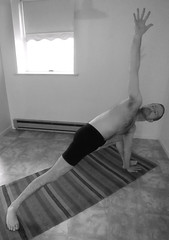
The Side-Angled Stretch (Parshvakonasana)
|
| Side Angle Stretch (Photo credit: Nicholas_T) |
Exhale and stretch right hand down to rest on floor behind right foot (for a beginner version, rest elbow on bent knee). Turn head to look up and press left hip flat against wall with left hand. A strong pull should be felt all along the left side. When you feel comfortable, stretch the left arm up and press it against your ear so that from left heel to left hand the body is stretched and extended. Hold this position for a slow count of 10, making sure that upper shoulder, hip and bent knee are pressed against the wall. Inhale and return to starting position. Exhale and repeat on left.
Benefits: This posture produces overall health. It tones every muscle, tendon and joint in the body. The heart is revitalized and strengthened, and, if crooked, the spine is stretched and realigned. The hip joints, which can weaken with age, become stronger and more flexible. The neck is stretched and made more flexible, easing the pain of stiff, tense muscles and spondylosis. Thighs, hips and waist are firmed. Even digestion is improved.
Remember to lie down and relax after your yoga practice. Relaxation after exercising helps the body to recover, regulates the flow of blood, and calms and soothes the mind. That way you don't feel tired but refreshed and invigorated.
The Triangle (Trikonasana)
 |
| Triangle Pose (Unsupported) (Photo credit: lululemon athletica) |
Exhale and slowly bend from waist, sliding your right hand down the right side as far as it will go. Shoulders should press back and hips should remain level, pointing forward. Head should be turned to the side, so that it's at a right angle to the body. Hold posture for 10 slow counts, inhale and come up to starting position. Exhale and repeat on left. Inhale and come up to starting position.
Exhale and rest a moment. Inhale and slowly raise arms to shoulder level, palms down. At the same time, point the right foot to the right at a 90-degree angle while keeping the left foot turned in slightly. Exhale and bend to the right, sliding hand down to ankle or foot. If possible, touch the ground behind foot. Pull hip square against wall with left hand and turn head to look up.
Inhale and raise left arm straight up over head so that arms are in a straight line. Keep hips and torso against the wall as both arms stretch, one down and one up, touching the wall. Hold posture with smooth, even breathing for a slow count of 10. Inhale, come up and repeat on left.
Benefits: Trikonasana helps produce excellent spinal flexibility. It stretches the legs, back and neck and helps to loosen up the hips and make them strong and flexible. It is also, to some extent, a balance posture; in yoga, it is believed that the skill developed in physical balance has a profound effect on the mind, quieting unruly emotions and creating calm. It is one of the best postures for slimming the waist, hips, arms and legs. Remember to breathe deeply in when stretching up and breathe deeply out when bending the body downward.
Tuesday, April 2, 2013
Yoga for Computer Users: Relieving Low Back Pain
Suffering with an episode of back pain this week (my last one was 6 months ago, and not that severe, so I've definitely been improving over the past few years!) I was reminded of how miserable it can make people. The default solution for back pain from the conventional medical industry is pain pills or surgery. However, twenty percent of all those who undergo surgery for lower back pain will get no relief. The remaining 80 percent will have continued problems ranging from mild to severe. All will have trouble with spinal flexion.
For some (like me) regular practice of yoga may help. Yoga does not offer cures. It simply promises that if you faithfully practice these asanas every day, there will be reduced episodes of pain and you will build up a strong and supple spine, restructuring posture and body image.
Once you have back problems you must remain conscious all through the day of how you stand, sit and lie down. Here are a few general guidelines:
You may wish to consult a chiropractor and see if they can be of help - in some cases of acute pain, a chiropractic adjustment can provide immediate relief.
When the pain is acute and you can neither sit nor stand in comfort, rest in bed, apply ice packs to the area regularly, take whatever anti-inflammatory or analgesic medications your physician prescribes, and wait until the pain is milder before attempting any yoga postures.
These yoga asanas have healing and curative properties. They will act as a form of mild traction, gently stretching the spinal muscles in safe extension postures. Strength will be gradually built up in the paraspinal muscles and buttocks, abdominal organs will be toned and strengthened, and pressure points all along the spine will be stimulated.
* The Diamond Posture (Vajrasana)
Kneel on a thick carpet or blanket with your knees close together. Sit back on your heels and stretch up from your hips, balancing your head well so that a line drawn through ear, shoulder, elbow and hip would be straight. You should sit often in this posture for greatest benefits.
The Locust (Salabhasana)
Most yoga students are familiar with this posture. Lie flat, face down, chin on floor. Make your hands into fists and push them either under your thighs to help the lift, or place them alongside your body. Exhale and lift legs from your hips, tightening your buttocks and stretching your legs up and back. Hold position for as long as possible, exhale, return to starting posture and repeat.
Cobra Pose (Bhujangasana)
Lie face down, legs stretched back, buttocks tightened and knees pulled back. Place hands just below shoulders, exhale and lift head, then chest, shoulders and torso, pushing down from your pelvis and straightening your arms. From the back of your head to your tailbone, your body should be curved back. Push shoulders back and down. Push head back more. Stay like this as long as possible with normal breathing. Come down very slowly, and relax.
The Twist (Bhardwajasana)
Kneel on the floor and sit back, bringing both feet to the right of your hips. Straighten your right arm, bring it across your body and turn to the left. Place your hand, palm down under your left knee. Exhale, turn your body more to the left and clasp your right elbow with your left hand, from the back. Turn your head and gaze over your right shoulder. Fold position for a few breaths and then twist and look back over your left shoulder. Shoulders should be at right angles to the body. Come back to starting position and repeat on other side. You should do this posture once every hour if you have lower back pain.
Check back later this week for some more yoga postures that can be of great benefit to frequent computer users, and others who spend much of their day sitting.
 |
| The lumbar region is most affected by sitting. (Photo credit: Wikipedia) |
Once you have back problems you must remain conscious all through the day of how you stand, sit and lie down. Here are a few general guidelines:
- Always sleep on a firm (not necessarily hard) bed, with a flat pillow under your head and a thicker one under your knees. This will help the spine to reposition and adjust itself.
- Do not wear high heels as this promotes lumbar lordosis and throws the spine out of balance.
- When experiencing pain (even mildly) do not go in for break-dancing, strenuous aerobics, jogging, running or anything where you need to bounce or jiggle. Guarded activity is the key here.
You may wish to consult a chiropractor and see if they can be of help - in some cases of acute pain, a chiropractic adjustment can provide immediate relief.
When the pain is acute and you can neither sit nor stand in comfort, rest in bed, apply ice packs to the area regularly, take whatever anti-inflammatory or analgesic medications your physician prescribes, and wait until the pain is milder before attempting any yoga postures.
 |
| Diamond Pose - Vajrasana (Photo credit: Wikipedia) |
* The Diamond Posture (Vajrasana)
Kneel on a thick carpet or blanket with your knees close together. Sit back on your heels and stretch up from your hips, balancing your head well so that a line drawn through ear, shoulder, elbow and hip would be straight. You should sit often in this posture for greatest benefits.
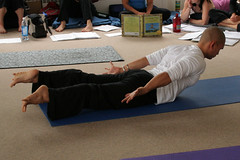 |
| Locust Pose (Salabhasana) A (Photo credit: dejahthoris) |
Most yoga students are familiar with this posture. Lie flat, face down, chin on floor. Make your hands into fists and push them either under your thighs to help the lift, or place them alongside your body. Exhale and lift legs from your hips, tightening your buttocks and stretching your legs up and back. Hold position for as long as possible, exhale, return to starting posture and repeat.
 |
| Cobra Pose - Bhujangasana (Photo credit: myyogaonline) |
Cobra Pose (Bhujangasana)
Lie face down, legs stretched back, buttocks tightened and knees pulled back. Place hands just below shoulders, exhale and lift head, then chest, shoulders and torso, pushing down from your pelvis and straightening your arms. From the back of your head to your tailbone, your body should be curved back. Push shoulders back and down. Push head back more. Stay like this as long as possible with normal breathing. Come down very slowly, and relax.
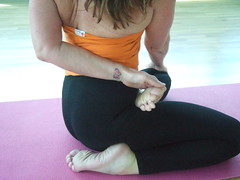 |
| Seated twist (Bharadvajasana) (Photo credit: yogamama.co.uk) |
Kneel on the floor and sit back, bringing both feet to the right of your hips. Straighten your right arm, bring it across your body and turn to the left. Place your hand, palm down under your left knee. Exhale, turn your body more to the left and clasp your right elbow with your left hand, from the back. Turn your head and gaze over your right shoulder. Fold position for a few breaths and then twist and look back over your left shoulder. Shoulders should be at right angles to the body. Come back to starting position and repeat on other side. You should do this posture once every hour if you have lower back pain.
Check back later this week for some more yoga postures that can be of great benefit to frequent computer users, and others who spend much of their day sitting.
Saturday, March 30, 2013
Video - Menopause Core Exercises
One of the main things you may notice when going through menopause is that you tend to accumulate more fat in the belly region. This is due in part to decreased metabolism (see last week's posts for help with this), and in part to hormone fluctuations. Regular cardio exercise (especially of the interval kind), together with exercises for a strong core can help you keep that flat belly even after menopause. This short video demonstrates three great core exercises that will help build and maintain core strength. They won't take long to do, and can be incorporated into your regular workout routine, or alternated on different days. (See instructions below video for set/rep information.)
Menopause Weight Loss | My Menopause Fix Blog
Menopause Weight Loss For more Videos and menopause weight loss information visit http://www.mymenopausefix.com If you would like my FREE 7 Day Menopause Die...
3 Simple Exercises for Toning the Core:
1) Hip Bridge - 20 Reps 2 Sets
2) 1 Leg Static Hip Bridge with Knee Taps - 10 each Leg 2 Sets
3) Reverse Tabletop Crunch ( Slow ) - 20 Reps 2 Sets

Menopause Weight Loss | My Menopause Fix Blog
Menopause Weight Loss For more Videos and menopause weight loss information visit http://www.mymenopausefix.com If you would like my FREE 7 Day Menopause Die...
3 Simple Exercises for Toning the Core:
1) Hip Bridge - 20 Reps 2 Sets
2) 1 Leg Static Hip Bridge with Knee Taps - 10 each Leg 2 Sets
3) Reverse Tabletop Crunch ( Slow ) - 20 Reps 2 Sets
Thursday, March 28, 2013
Adding Exercise to Your Arthritis Treatment
Arthritis is an ailment which affects millions of people. While some people may experience mild discomfort, others are in horrible and debilitating pain every single day. No matter how mild or severe your pain is, you can probably benefit from some exercise. Not only will it improve your overall health, it may also help combat some of your symptoms, leaving you pain free and help you with your symptoms.
We all know the importance of exercise, but arthritis patients will probably benefit more from strength straining exercises targeting their affected joints. The best way to get this kind of workout is through a physical therapist. They can provide you with exercises designed specifically to improve endurance, and muscle strength. If you perform these exercises as prescribed, you will probably find yourself feeling better, or at least not deteriorating as quickly. You may be able to do more, or your condition may simply worsen more slowly. You can’t reverse the damage arthritis as caused, but you may be able to improve your quality of life.
Another type of exercise your physical therapist will probably recommend is flexibility training. Many arthritis patients lose flexibility and range-of-motion in affected joints because pain is causing them to use the joint less. Flexibility exercises can help keep the joints limber, enabling a better range or motion and increasing how much you can do with that joint.
A good cardio workout is just as important for people with arthritis as it is for everyone else. However, unlike everyone else, people with arthritis don’t skip aerobic exercise because they’re busy, or tired - it’s because they’re in pain. If performing everyday activities is painful, then you probably don’t want to consider doing anything more than that; however, there are exercises you can do to work your heart without severe pain or a worsening of your condition. You should work with your doctor to find exercises that don’t stress, or even involve, the affected joints. For instance, patients with severe knee arthritis can get aerobic exercise with table top bike-like devices which you pedal with your hands. While this doesn’t help your affected joints directly, it improves your overall health, endurance, stamina, and circulation, which can improve your ability to handle your arthritis. Exercise can also temporarily relieve pain through chemicals in the blood.
While exercise isn’t going to cure your arthritis, it may help to improve your condition. To work properly, exercise should be combined with proper diet, getting enough rest, supplementation, and other treatments your doctor may recommend. A combination of these therapies goes a long way for reliving arthritis pain.
 |
| Hip dysplasia with arthritis (Photo credit: Wikipedia) |
Another type of exercise your physical therapist will probably recommend is flexibility training. Many arthritis patients lose flexibility and range-of-motion in affected joints because pain is causing them to use the joint less. Flexibility exercises can help keep the joints limber, enabling a better range or motion and increasing how much you can do with that joint.
A good cardio workout is just as important for people with arthritis as it is for everyone else. However, unlike everyone else, people with arthritis don’t skip aerobic exercise because they’re busy, or tired - it’s because they’re in pain. If performing everyday activities is painful, then you probably don’t want to consider doing anything more than that; however, there are exercises you can do to work your heart without severe pain or a worsening of your condition. You should work with your doctor to find exercises that don’t stress, or even involve, the affected joints. For instance, patients with severe knee arthritis can get aerobic exercise with table top bike-like devices which you pedal with your hands. While this doesn’t help your affected joints directly, it improves your overall health, endurance, stamina, and circulation, which can improve your ability to handle your arthritis. Exercise can also temporarily relieve pain through chemicals in the blood.
While exercise isn’t going to cure your arthritis, it may help to improve your condition. To work properly, exercise should be combined with proper diet, getting enough rest, supplementation, and other treatments your doctor may recommend. A combination of these therapies goes a long way for reliving arthritis pain.
Tuesday, March 26, 2013
Why Exercise Is Important During Menopause
We all know that getting enough exercise is a vital part of staying healthy. What you may not know is that the older you get, the more important it is for you to work out regularly. As your body starts to change, you not only may experience hot flashes and mood swings, you’re also at a higher risk for dangerous diseases. The good news is that many menopausal symptoms can be helped or even stopped through regular physical activity.
One of the biggest concerns for women approaching menopause is the loss of bone mass. This can lead to osteoporosis and other serious consequences. Many doctors suggest getting plenty of calcium to help prevent bone deterioration, but this is just the first step. Getting regular, weight-bearing exercise is also essential for maintaining good bone health. If you’re not in very good shape, walking other light exercise can be enough to get started. You should eventually work yourself up to resistance training. This is the best way to slow or even stop loss of bone mass. You should also consider adding flexibility training; being limber will keep you from getting injured sometime down the road. (Yoga is often a great choice, as it combines weight-bearing exercise with flexibility training - and in some types of yoga, even cardiovascular benefits.)
Along with osteoporosis, women who have reached menopause are also at an increased risk of developing heart disease. Many women assume that only men are at risk, but heart disease is a top killer of women as well as men. Plus, women are less likely to know they’re having a heart attack, so they don’t get treatment as quickly. Regular aerobic exercise can do wonders for keeping your heart in good shape. Even if you aren’t going through menopause yet, getting regular exercise is a great way to keep your heart healthy for a long time.
Another common symptom of menopause is mood swings. As estrogen levels fluctuate, so do your emotions. And unlike mood changes due to your menstrual cycle, menopausal mood fluctuations are much less predictable. Exercise can work to ease symptoms of depression, decrease mood fluctuations, and decrease irritability. Exercise helps you to be more emotionally stable so you can worry about more important things.
With the onset of menopause, many women gain weight. While it’s usually not a substantial amount, it can increase the risk of certain weight related diseases. Regular exercise can help you keep your weight in check, reducing the risk of serious health problems in the future.
If your biggest concern about menopause is the immediate physical symptoms, exercise can be a great cure for you too. Many women notice a decrease in hot flashes and other physical symptoms when they go on a regular exercise program.
Sure, regular exercise takes some planning and work, but your health is worth it, so get out and get moving - no matter what age you are!
 |
| Aerobic exercises (Photo credit: Wikipedia) |
Along with osteoporosis, women who have reached menopause are also at an increased risk of developing heart disease. Many women assume that only men are at risk, but heart disease is a top killer of women as well as men. Plus, women are less likely to know they’re having a heart attack, so they don’t get treatment as quickly. Regular aerobic exercise can do wonders for keeping your heart in good shape. Even if you aren’t going through menopause yet, getting regular exercise is a great way to keep your heart healthy for a long time.
 |
| gymnasium braille ada sign (Photo credits: www.mydoorsign.com) |
With the onset of menopause, many women gain weight. While it’s usually not a substantial amount, it can increase the risk of certain weight related diseases. Regular exercise can help you keep your weight in check, reducing the risk of serious health problems in the future.
If your biggest concern about menopause is the immediate physical symptoms, exercise can be a great cure for you too. Many women notice a decrease in hot flashes and other physical symptoms when they go on a regular exercise program.
Sure, regular exercise takes some planning and work, but your health is worth it, so get out and get moving - no matter what age you are!
Subscribe to:
Posts (Atom)